Checklist for SAT Math Geometry and Trigonometry
With a few strategy tips added in
Geometry and Trigonometry makes up about 15% of the SAT Math (about 3-4 questions per 22-question module). However, that doesn’t mean there isn’t a lot of content that could come up in those questions. So while geometry shouldn’t be the #1 priority for most students preparing for the SAT Math, it does take a significant amount of preparation to be sure you’ll be ready for all the Geometry and Trigonometry content that could be thrown at you.
At present this article functions mostly as a checklist of background knowledge for the SAT Math Geometry and Trigonometry, rather than a full walkthrough of all the major question types. It assumes familiarity with the facts on the official reference sheet, and many parts are not fully explained. It also only mentions a few points of test strategy. But if you know these facts (and know the facts on the reference sheet or how to read it) then you have all the necessary building blocks for answering SAT Geometry and Trigonometry questions. Contact me if you see something on here you’d like elaborated on.
All answers to included SAT question bank questions can be found most easily here, using the number at the top. All questions and answers originally come from here, although I’ve added my own numbering for ease of communication.
These are loosely organized by the skills the SAT uses to organize geometry questions, but some things, like the Pythagorean Theorem, are relevant throughout
Lines, Angles, and Triangles
• Know which angles that are congruent (corresponding angles, vertical angles, angles opposite equal sides of an isosceles triangle)
• Know which angles that add to 180 (linear pair, consecutive interior angles, three interior angles of a triangle)
• Four angles created by two lines intersecting at a point add to 360, 2 pairs of vertical (equal) angles
• When we name polygons, the order of the points matters. If we say triangle ABC is similar to triangle DEF, then it’s the angle at B that’s congruent to the angle at E. We call B and E corresponding. The side BC also corresponds to the side EF, etc.
• Corresponding parts of congruent triangles (or other polygons) are congruent
• Corresponding angles of similar triangles (or other polygons) are congruent
• Corresponding sides of similar triangles (or other polygons) are proportional
• Common ways of determining congruent and similar triangles (the SAT will use similar triangles more often because there’s more to do with them: it is easier to create problems that are partly about geometry concepts and partly about calculation when you use similar triangles rather than congruent triangles)
• AA similarity criterion: knowing that two angles are congruent tells you that two triangles are similar
• SAS similarity criterion: knowing that two pairs of sides are proportional in length and the angle between them is congruent tells you that the two triangles are similar
• No SSA similarity criterion: Unless the two triangles are both right triangles, then knowing that two sides are proportional doesn’t tell you they are similar unless the angle is a right angle
• Patterns of similar right triangles (2 triangles nested one in another sharing an angle; 3 triangles where the short leg of big triangle is hypotenuse of small triangle, long leg of big triangle is hypotenuse of medium triangle)
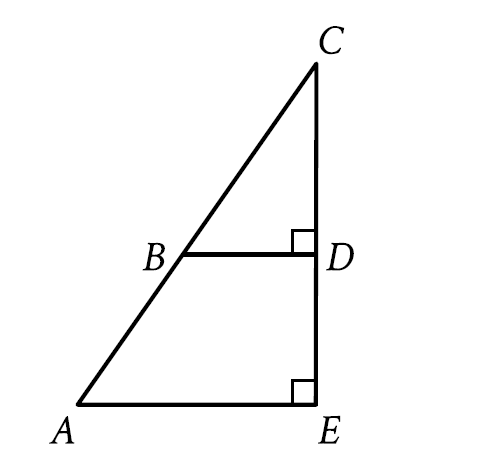
It’s helpful to recognize on sight that these two triangles are similar. You can also see this pattern without the similar triangles being right triangles but it’s especially helpful on the test to be ready for this kind
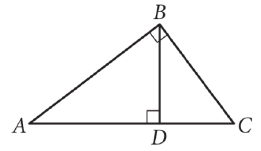
It’s helpful to recognize on sight (and maybe a bit surprising!) that these three right triangles are all similar
• Pythagorean Theorem. Notice the difference between a question where the hypotenuse is missing and both legs are given, and a question where the hypotenuse and one leg are given, and the other leg is missing
• Special right triangles. The 45-45-90 triangle is isosceles, and is half a square, the 30-60-90 triangle is half of an equilateral triangle. Using this, we know that an equilateral triangle is wider than it is tall.
For equilateral triangles
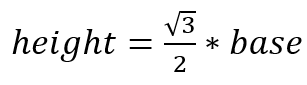
• Finding either special right triangle can be the key to solving a more complex problem with multiple shapes
• Remember, only for right triangles can you find the area by multiplying
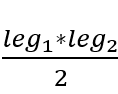
That works for right triangles because the two legs are perpendicular. For other triangles, the height perpendicular to a side is inside the triangle (or in obtuse triangles can be outside).
Right Angles and Trigonometry
• Definitions of three basic trig functions:

• By opposite we mean the leg opposite to the angle with measure x, and by adjacent we mean the leg adjacent to the angle with measure x. By this definition, the sin of one acute angle in a right triangle is the cos of the other acute angle in the triangle. This is related to
Cofunction identity (what you could call “the SAT’s favorite hard trig fact”): if two angles add up to 90 (complementary angles), the sin of one is the cos of the other. This follows from the definitions, but remembering it separately will be the key to some hard questions
• Know also that for two complementary angles, the tangent of one is the inverse of the tangent of the other (they multiply to 1)
Circles
• Circle Formula:

The center of the circle is (h,k), and the radius is r. These two things, the center and the radius, determine the circle
• This is based on the distance formula:

(if you square the distance formula, it looks just like the circle formula)
because by definition the circle is all the points which are some fixed distance from some point (x-sub-1, y-sub-1). We call that distance r, the radius, and we call the center point (h,k). You may see that this is also closely related to the Pythagorean theorem.
• Completing the square, both for x and y, to finish the circle formula and find what the center and radius are. Know how to complete the square
• You can also often plug an equation for a circle into DESMOS, and if you do it won’t matter whether you’ve put it into the proper form for the circle formula
Diagonal of a rectangle and/or diameter of circle or radius of circle is often the hypotenuse of some right triangle. This is strategically important; problems with multiple shapes in them are usually at least partly about triangles, using either right triangles (use the Pythagorean theorem or special right triangles) or isosceles triangles (angles opposite to equal sides are also equal)
• Tangent line to a circle (line that just touches a circle at one point without crossing into it) is perpendicular to radius. This is a different use of “tangent” from the trig function tangent, which will typically be referred to just as tan
• This can, in coordinate geometry problems, be used in combination with the fact that perpendicular lines have slopes that are negative reciprocals of each other (they multiply to -1)
• This can also be used in a multi-shape problem to create a right triangle on which you can use the Pythagorean theorem
• It’s good to know the basic points on the unit circle, but you can also check them using DESMOS (as long as you make sure you’re in the right mode, radians or degrees)
Know also that if you subtract 2π radians (or 360 degrees) from an angle, you get the same angle as far as the trig functions are concerned.
Area and Volume
• The next couple facts use a concept called the scale factor: the ratio of the side lengths two similar polygons
• The perimeter varies directly with (multiplies with) the scale factor. So if one polygon has sides 3 times as long as another it’s similar to, its perimeter is 3 times as much
• The area varies directly with the square of the scale factor. So if one polygon has sides 3 times as long as another it’s similar to, its area is 9 times as much
• All circles are similar. So if one circle has a radius 3 times as much as another, its circumference is 3 times as much and its area is 3 times as much
• This is related to an important question about units that many students struggle with—how many square feet are in a square yard? There are 3 feet in a yard, but a square foot is a foot long and a foot wide, and a square yard is a yard long and a yard wide. If you picture it, you can definitely fit more than three square feet in a square yard. There are 9 square feet (because 9 is 3 squared) in a square yard
• Less likely to come up, but the volume varies directly with the cube of the scale factor. So if one 3-dimensional figure (prism, cylinder, cone, or sphere) has sides 3 times as long as another it is similar to, its volume is 27 times as much
• Surface area of a 3-dimensional figure is a 2-dimensional quantity, so it scales with the square of the scale factor. So if a prism has sides 3 times as long as another it’s similar to, its surface area will be 9 times as much
• When they say “right circular cone” or “right circular cylinder,” they just mean the normal cone and cylinder in the formula sheet—not tilted and has a circle for the base
• Why do they use these terms? The test is sometimes more precise than they need to be for most of us, just so the people who know the more advanced and precise term can’t object that the test was unclear
• The “slant height” of a cone is the height to climb up the side to the tip from the base. Use the Pythagorean theorem—

• Know how to convert between surface area and volume of a cube. Use the one given to get the edge length (or side length, but I’m saying “edge
here and not “side” to avoid confusion with the face of a cube or 3-D figure, which we also colloquially call a “side”), and then use the edge length to get the other
• For surface area of a rectangular prism, know that a rectangular prism has three pairs of rectangular faces, so three different areas (unless two edges are equal, in which case two faces are squares, and the other four are congruent rectangles). Think of a paperback book: the front and back faces have the same area (long edge medium edge), the spine and open side have the same area (long edge narrow edge), and the top and bottom have the same area (narrow edge * medium edge). So the surface area of the book is 2(front area) + 2* (spine area) + 2*(top area)
Extra points about strategy with coordinate geometry
• Some of the hardest area/perimeter/circumference questions could involve a coordinate plane. If you need to know a length, you can use the distance formula. If you need to know an area, you can create a rectangle and then subtract right triangles from it (as mentioned above, right triangles are the easiest triangles to find the area of)
• Three points determine a circle. As mentioned above, a circle is the points that are all the same distance form some center. So if you get 3 points of a circle and have to determine something about it, first figure out which point is the same distance from all 3 of the given points. That’s the center, and the distance between the center and any of the points you started with is the radius. From there you can use the formula sheet to find the circumference, area, or whatever else you need to know.
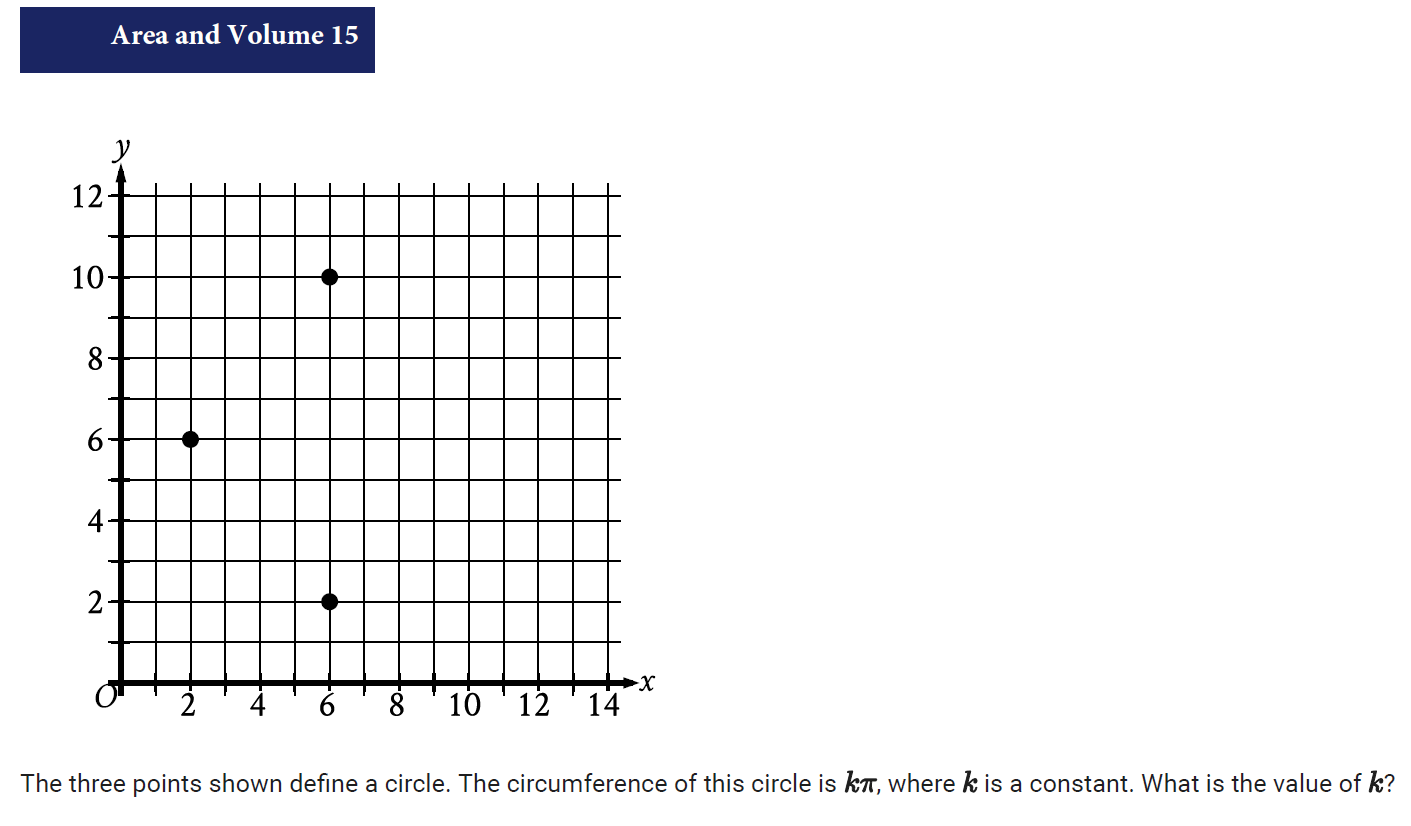
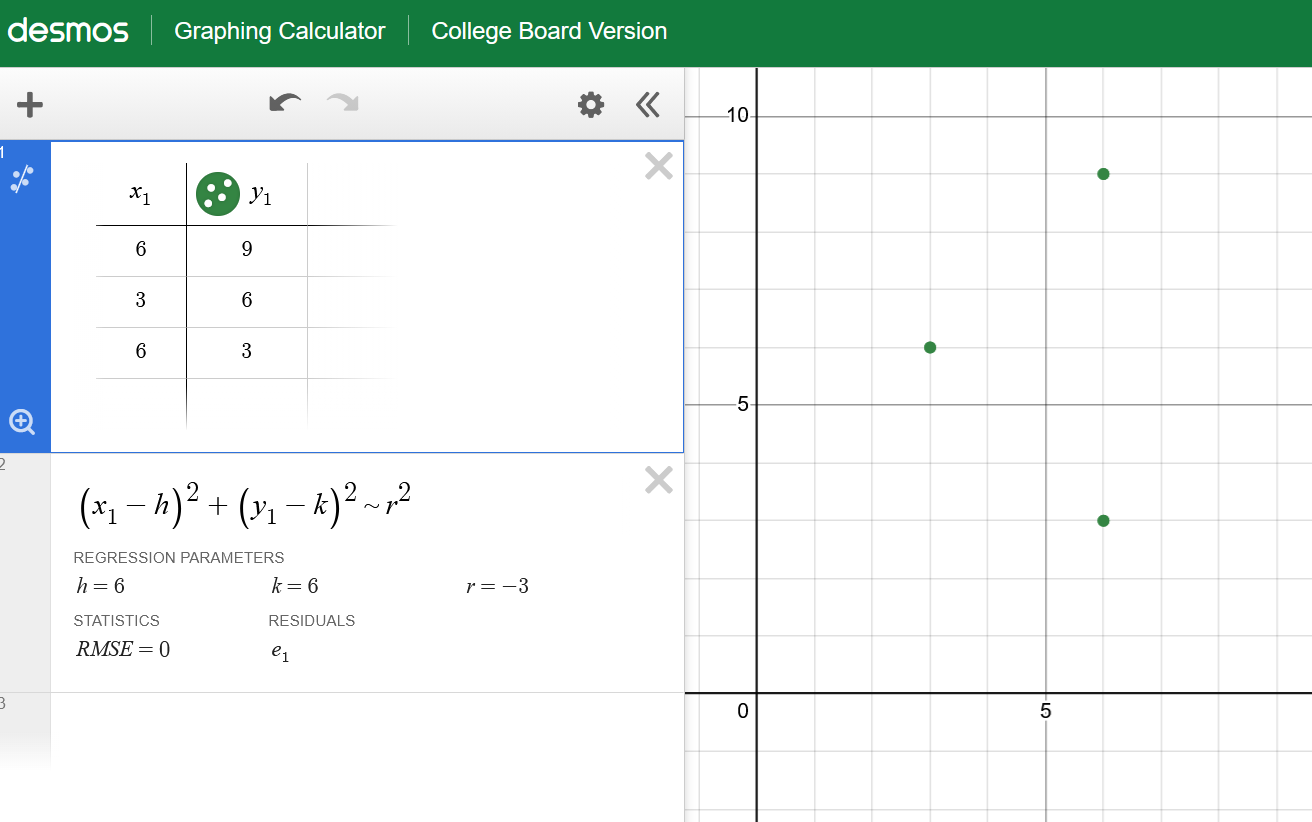
If you can’t figure out the center of the circle from looking at the points, you can use DESMOS to help you. Create a table and put in each of the three points. Then use regression with the circle formula (remember to use x-sub-1 instead of x, y-sub-1 instead of y, and the tilde symbol ~ instead of the equals symbol = ). I’ll create a separate post on DESMOS techniques in the future, but you can create a table just by typing “table” and you can type x-sub-1 just by typing “x” and then typing “1” immediately after, with no spaces. Note that on this problem, the DESMOS route is probably slower than the eyeball route for determining the center. Also, of course, we know the radius is positive, so we ignore the negative solution DESMOS gives us for r.