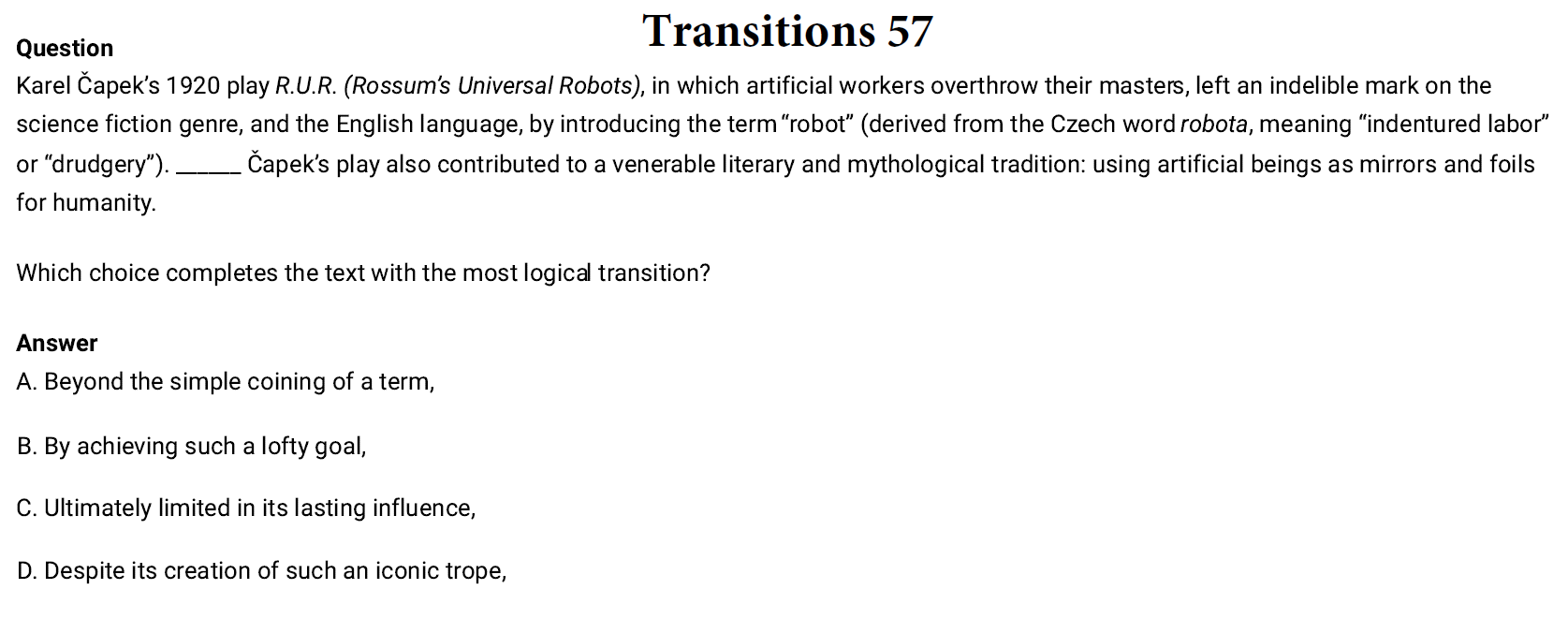
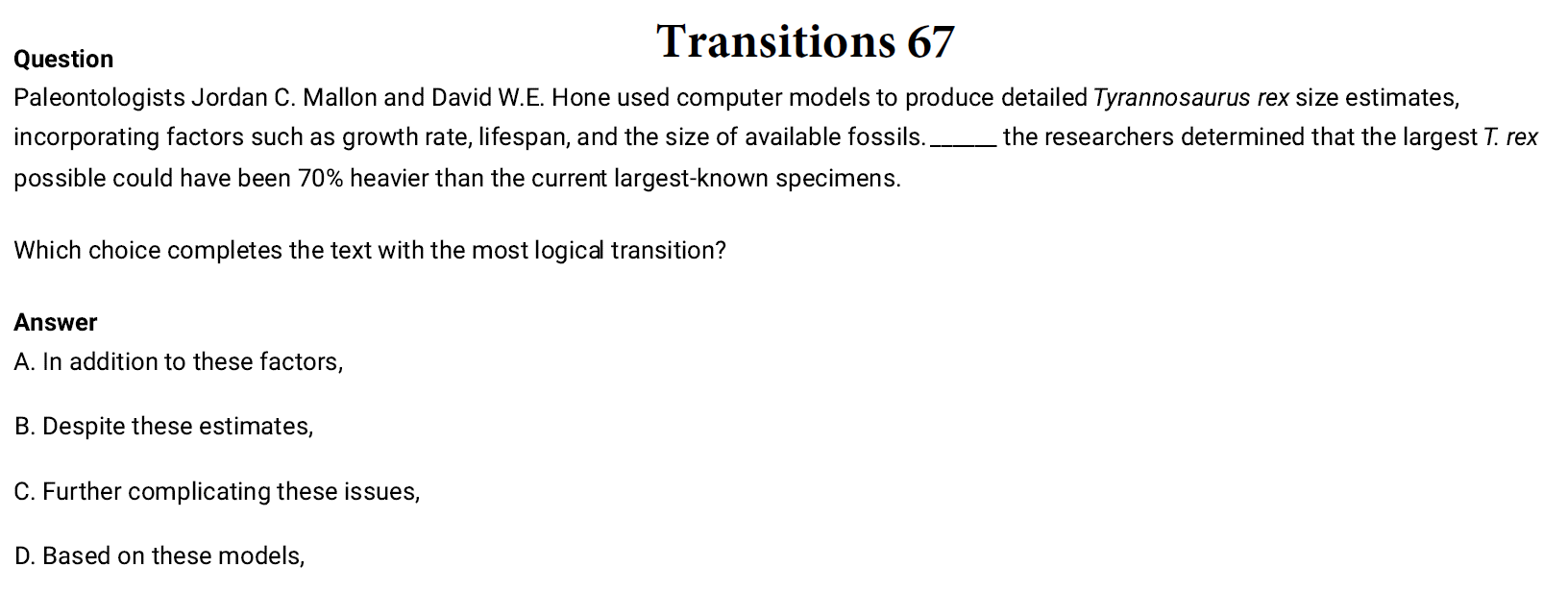
SAT Expression of Ideas: Transitions
Updated to reflect new words in Question Bank questions released 7/31/26
“Transitions” questions are the next-to-last type of question in each module of SAT Reading/Writing. They are the first half of “Expression of Ideas.” They test your ability to find the right connecting word or phrase between two parts of a paragraph.
There are typically about 3 of them in a module, but released tests have anywhere from 1 to 5 in a module.
The basic ideas behind them are also relevant to reading questions, especially Inferences and Text Structure and Purpose. But they involve a lot less reading than those questions.
Contact me if you see something on here you’d like elaborated on.
All answers to included SAT Question Bank Transitions questions can be found most easily here, using the number at the top. All questions and answers originally come from the official SAT Question Bank, although I’ve added my own numbering for ease of communication. If you want to do the questions and check your answers as you read, I’d recommend clicking the bold link now so you have it ready.
Paragraphs
To understand transition words, we need to think about paragraphs. Why do we have paragraphs?
We have them to express a longer thought that we can’t easily express in a sentence
We connect shorter, more easily digestible thoughts (sentences) into a complex whole that is still manageable
Transition Words and Phrases
Transition words and phrases are like the joints of paragraphs (or of even larger units)
They’re one way of making sure a paragraph hangs together
Sometimes, a more expansive transition is used. I look at a couple questions that use this kind of transition at the end. The College Board has only released 2 questions of this type, neither of which are ranked “hard.” So there’s no concrete indication that these will show up to add flavor to a hard second module. I include the two released examples at the end and say a bit about them.
Types of Paragraphs
To know which transition word we need, we need to figure out what the paragraph is trying to do. Why did we put these sentences together? What can they do in a paragraph that they couldn’t do on their own?
Example:
One thing we can do with a paragraph is express a thought and then give a reason or evidence for accepting it
This could be done in a sentence, but putting it in a paragraph helps makes clear the division between the two thoughts, and the relation the author or speaker sees between them.
Rote memorization is a bad way to learn math. Indeed, students who learn math by rote memorization consistently show weaker performance on tests of real-world application of math knowledge.
The separation into sentences helps the reader see that these are distinct thoughts, while the addition of an effective transition word helps make clear what the relationship between the sentences is.
So, if we categorize transition words by the type of paragraph they help make possible, we can get a clearer picture than if we were to just try to group them into synonyms
“Indeed” was a good case to start with because it can be used for a couple different types of paragraphs. You might use it if you want to express a thought and then give a reason for accepting it, as in the example before, or if you want to express a thought and then emphasize it, as below.
“The ideas of economists and political philosophers, both when they are right and when they are wrong, are more powerful than is commonly understood. Indeed, the world is ruled by little else.”
--John Maynard Keynes
I’ve created a graphic that organizes a large number of transition words by the types of paragraphs they tend to appear in
This categorization captures all the words used in official practice tests or SAT question bank questions, and a few more mentioned in the College' Board’s Official Guide to the Digital SAT
The words that are underlined and in bold are especially common
You can tell from the fact that three phrases in “give examples” are all in bold that that is a very common category on the test
The words that aren’t in bold all come up at least once in the SAT Question Bank, the official practice tests, or the Official Guide
But there can always be more uncommon words and phrases. After all, some of the words here used are only used once in the Question Bank. So even as you learn which category these words go in, you also need to keep your eyes on the categories themselves, to hone your critical reading skills, so that you can be ready for the unexpected.
“After all” is one example of an uncommon but possible phrase you need to be ready for. I could also have used “indeed” there
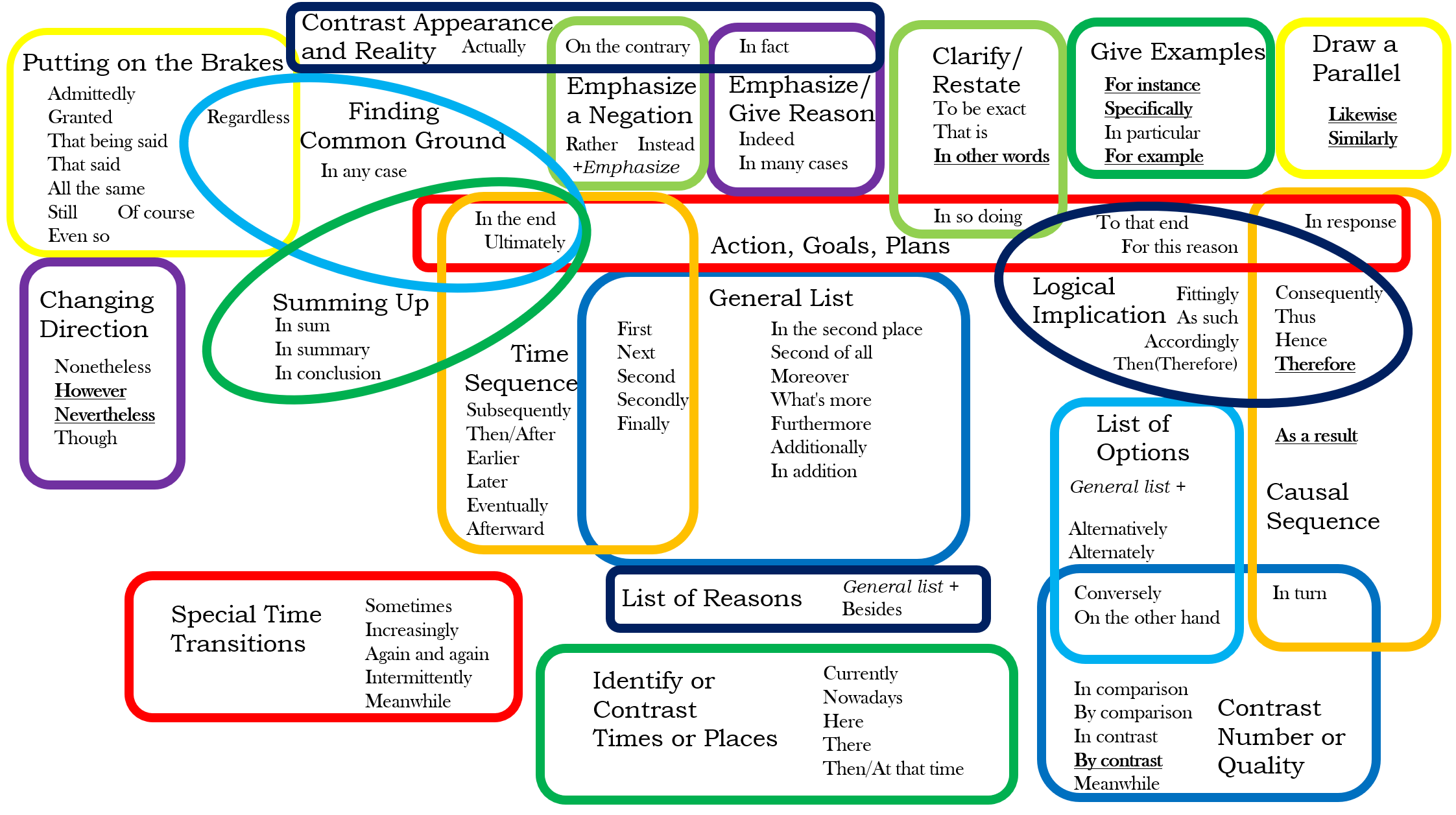
Don't view this diagram too rigidly. I've made it as accurate as I can; nevertheless, the goal is not to give you the final rule for all time about how various transition words can be used in all contexts. Instead, it's
1. to introduce you to words you don't know, and show how they're related to words you do know
2. to get you thinking about how these distinctions work
Notice that, except for the two red boxes, “Special Time Transitions” and “Actions, Goals, Means,” each box corresponds to an overall paragraph structure. So, for example, “Clarify/Restate” corresponds to a paragraph that introduces a claim and then clarifies or restates it.
“Actions, Goals, Plans” describes a topic for a paragraph—actions or plans—but not one overall paragraph structure.
“Special Time Transitions” collects transitions that could fit into a number of paragraph structures including change over time.
Now, we’ll look in more detail at types of paragraphs.
But before we do, note that a given paragraph structure can also be nested within another one
You could go home. Alternatively, you could go to the moon.
We would say this is a List of Options
You could go home. Alternatively, you could go to the moon. In any case, you need to get out of my store.
This would be Finding Common Ground (between options)
General List
Could be a list of anything
Transition words used for this type of paragraph include:
Firstly
Secondly
In the second place
Second
Second of all
Finally
In addition
What’s more
Moreover
Additionally
Furthermore
Next
In addition
In sum
In summary
In conclusion
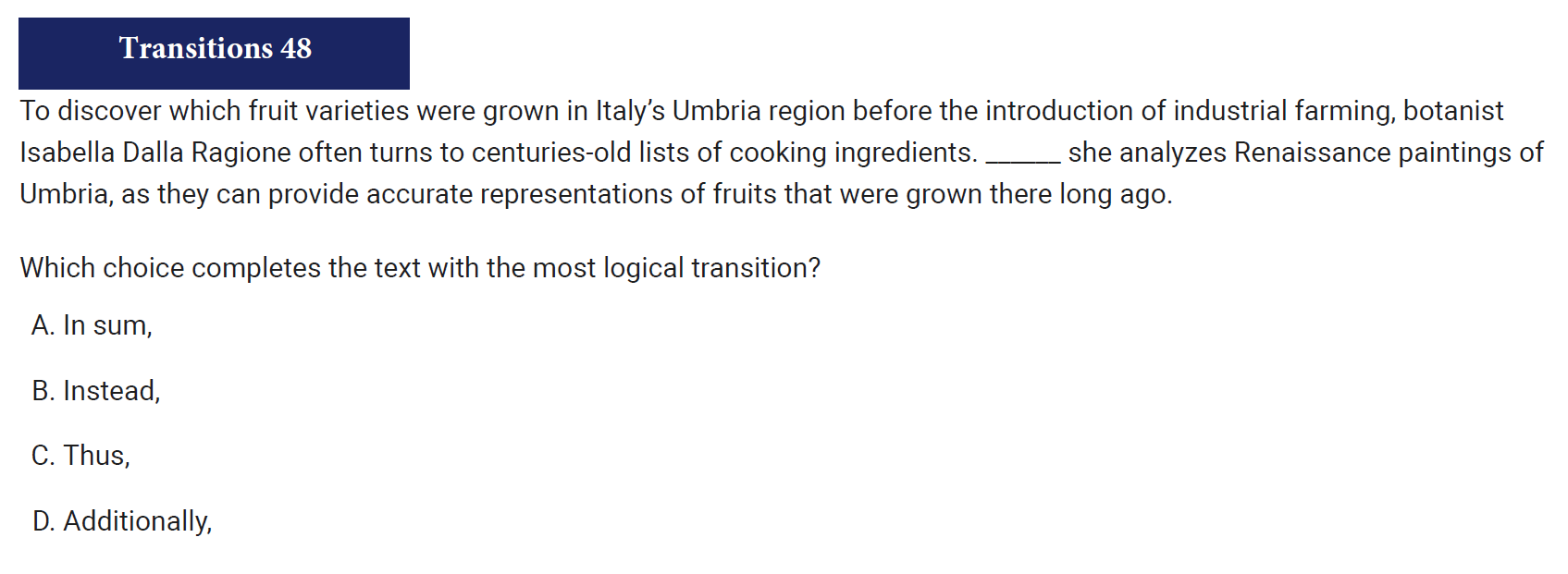
Most of the included Transitions questions here are basically given away by the category they’re put under. So they’re more here for illustration than for real practice. If you want to get more real practice, or to see the answer explanations given by the College Board for the included Transitions questions, you can find all that here.
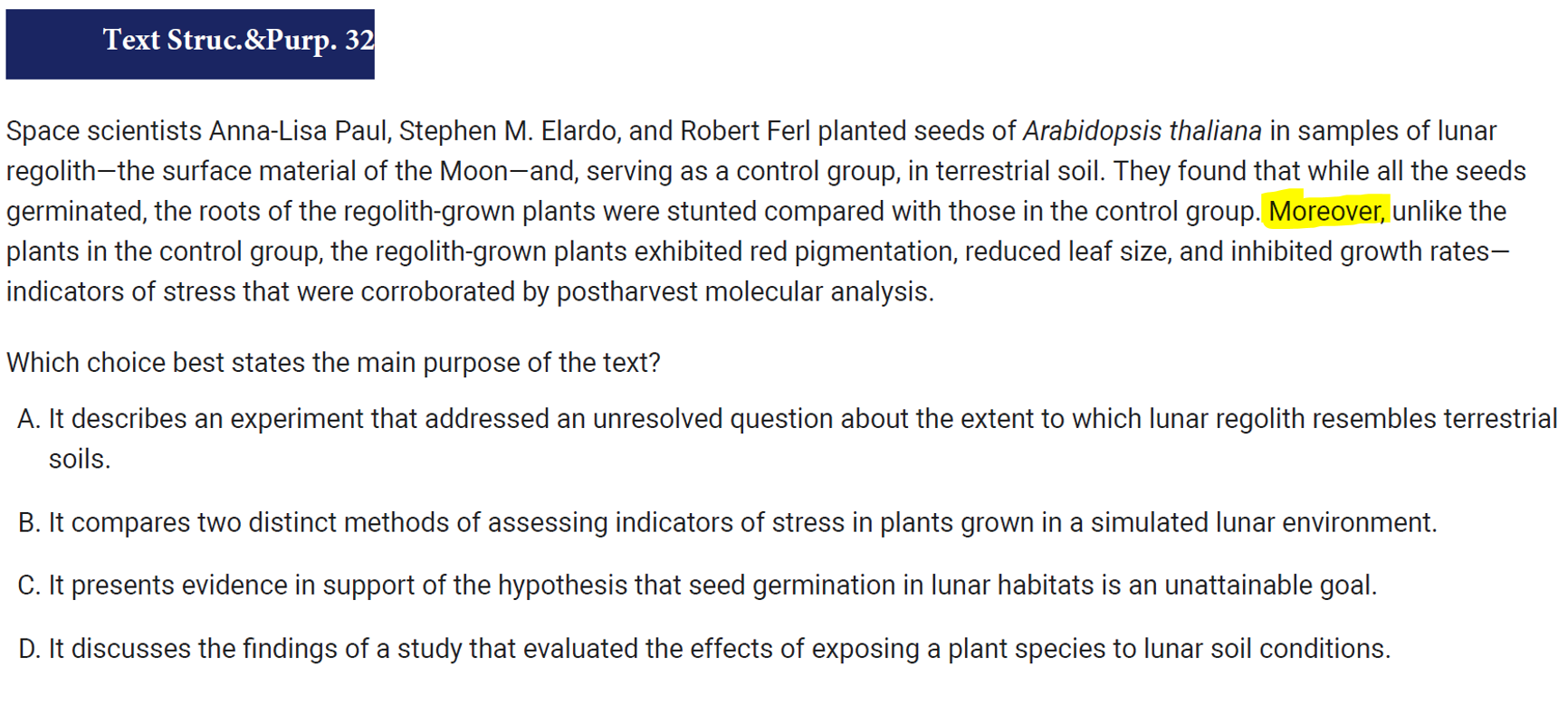
Answer here. I’ve included some questions from Text Structure and Purpose, Inferences, and Boundaries, not only to include some questions that aren’t given away by their category, but also so you can see longer examples of these paragraph types, written in the SAT’s own style.
Contrasting Number or Quality
This is our “general contrast” category. One thing to note (though it won’t be decisive in test questions, as it’s too fine-grained a distinction): when it comes to the difference between “in/by contrast” and “in/by comparison,” what you tend to hear is that comparison has to do with similarity, and contrast tends to do with difference. There’s something to that, but in language the difference tends to be that when we say “in/by comparison,” we’re referring to two things we can put directly in front of our eyes and see the difference for ourselves. So “in/by comparison” will be more often used in questions involving numbers, which you can directly compare.
In contrast
By contrast
In comparison
By comparison
On the other hand
Conversely
Meanwhile
In turn
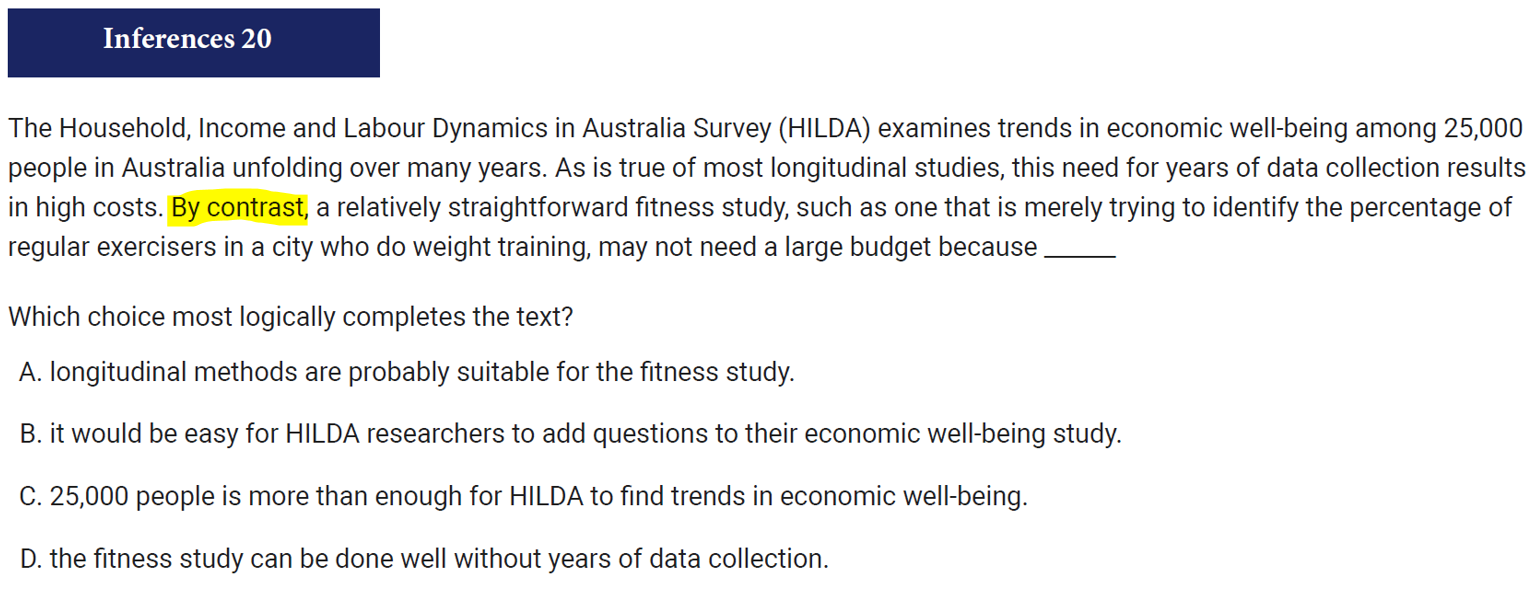
Answer here
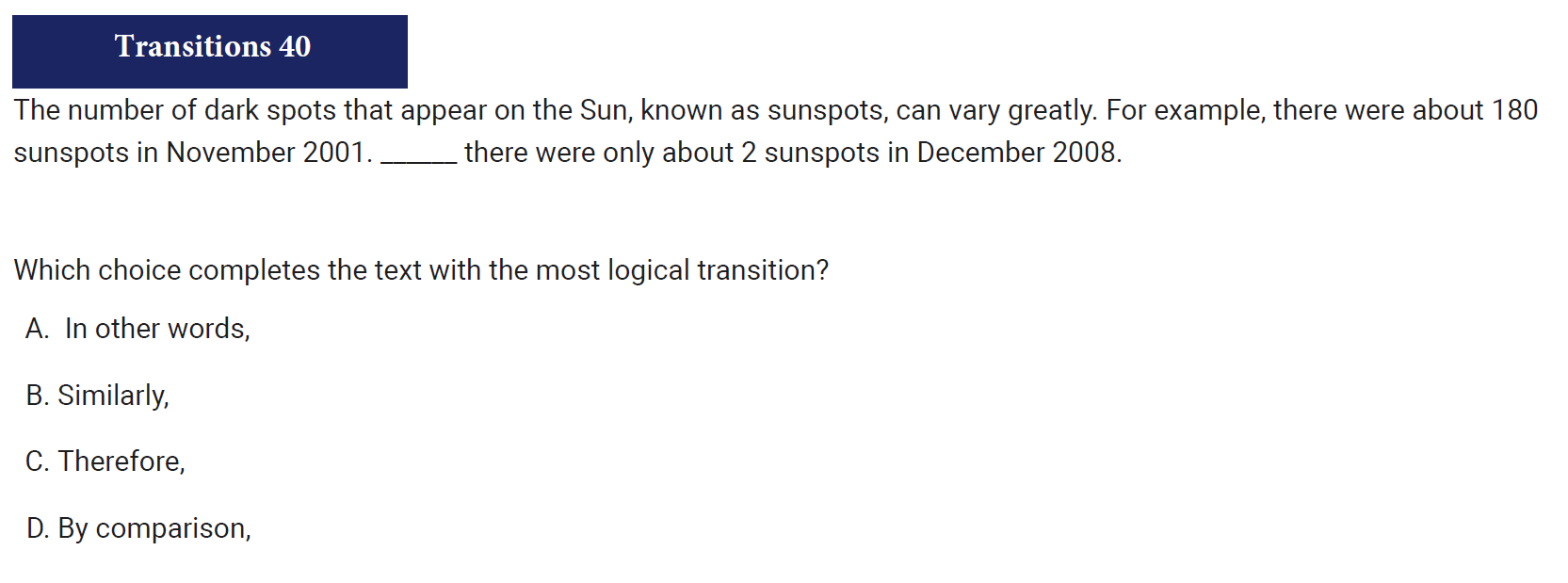
Identifying or Contrasting Times or Places
Some time words aren’t so much about putting events in a sequence as they are about referring to a particular time, perhaps to contrast the way things are at two times. If we say “in the nineteenth century riding horses was fairly common, whereas nowadays it’s not,” then we don’t necessarily care about which came first; we may just care about comparing/contrasting the two settings. This kind of time comparison is similar to a place comparison, which doesn’t in general have a particular order.
Currently
Nowadays
Here
There
Then/At that time
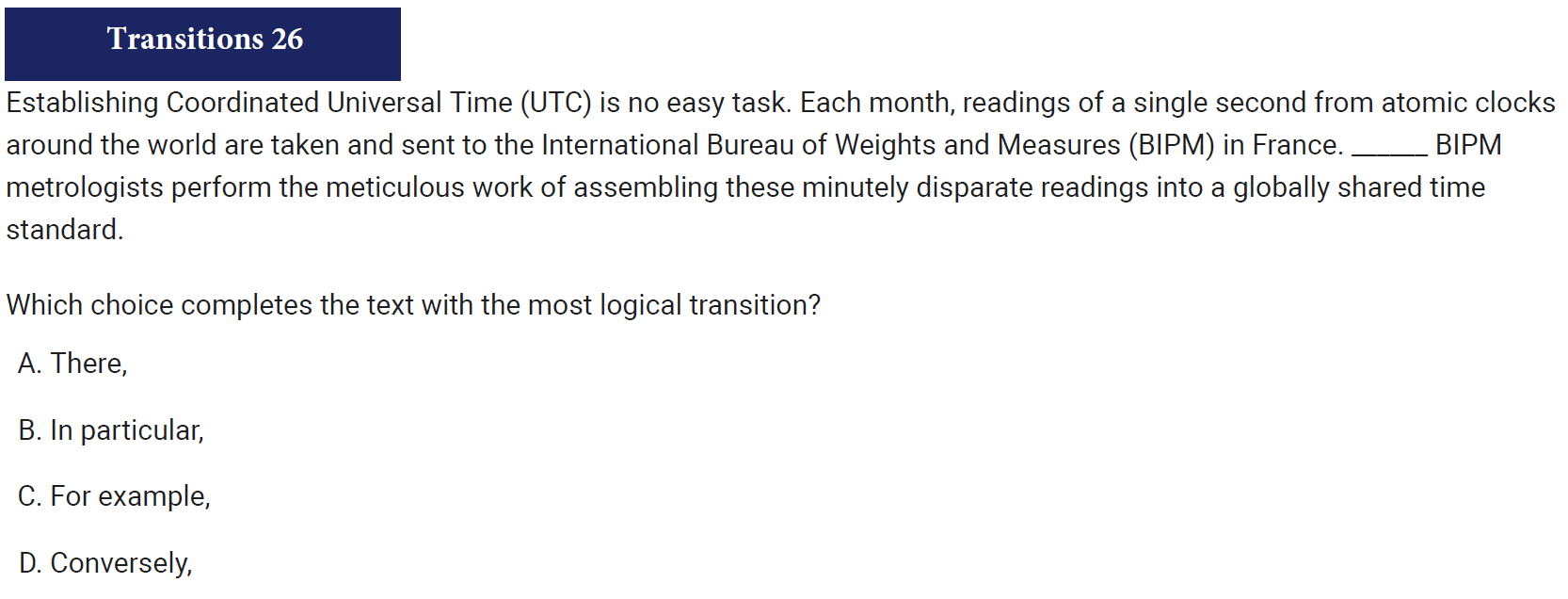
The fact that this question is about readings of time is a coincidence. What matters is that what links the sentences together is a reference to a place.
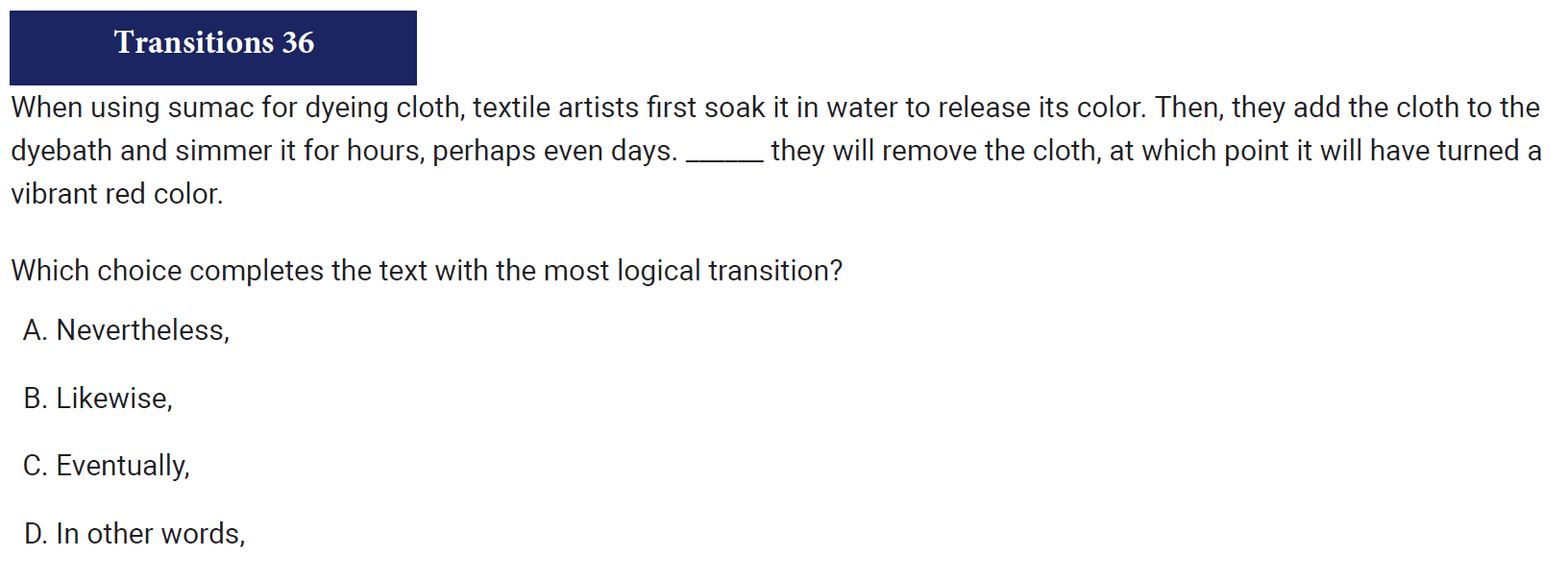
Time Sequence
This paragraph type can seem at first a lot like a list. But certain phrases used in some lists, like “second of all,” imply that something other than time (perhaps something as simple as “this is the order in which I saw fit to give these reasons”) is ordering the list. Furthermore, certain words specifically indicate a time sequence, like “subsequently,” and shouldn’t be used in a general list.
First
Next
Second
Secondly
Finally
Subsequently
Then/After
Afterward
Eventually
Earlier
Later
Ultimately
In the end
Special Time Transitions
Time is such a central part of human experience, and such a frequent reference point in our language, that some transitions reference time but don’t do so in a way that simply orders events or picks out a time. They sometimes do more specific things that we shouldn’t give a whole category to. For example, we could say that “increasingly” describes change over time, whereas “again and again” describes continuity over time. You can probably think of other transitions that could go into this catch-all category, and the test-makers can too.
Sometimes
Again and again
Increasingly
Intermittently
Meanwhile
Example: After he got home from the audition, he could think of nothing but whether he would get a callback. Intermittently, he would attempt to pull himself from the couch or his phone or both and make something of his day, but the anticipation always pulled him back to that posture.
List of Options
Alternatively
Alternately
Conversely
On the other hand
Firstly
Secondly
In the second place
Second
Second of all
Finally
In addition
What’s more
Moreover
Additionally
Furthermore
Next
In addition
Example: First of all, we could go get ice cream to celebrate. Second, we could go to the movies instead. Alternatively, we could forget about celebrating and go pick up some decorations for the holiday dinner.
List of Reasons
Besides
Firstly
Secondly
In the second place
Second
Second of all
Finally
In addition
What’s more
Moreover
Additionally
Furthermore
Next
In addition
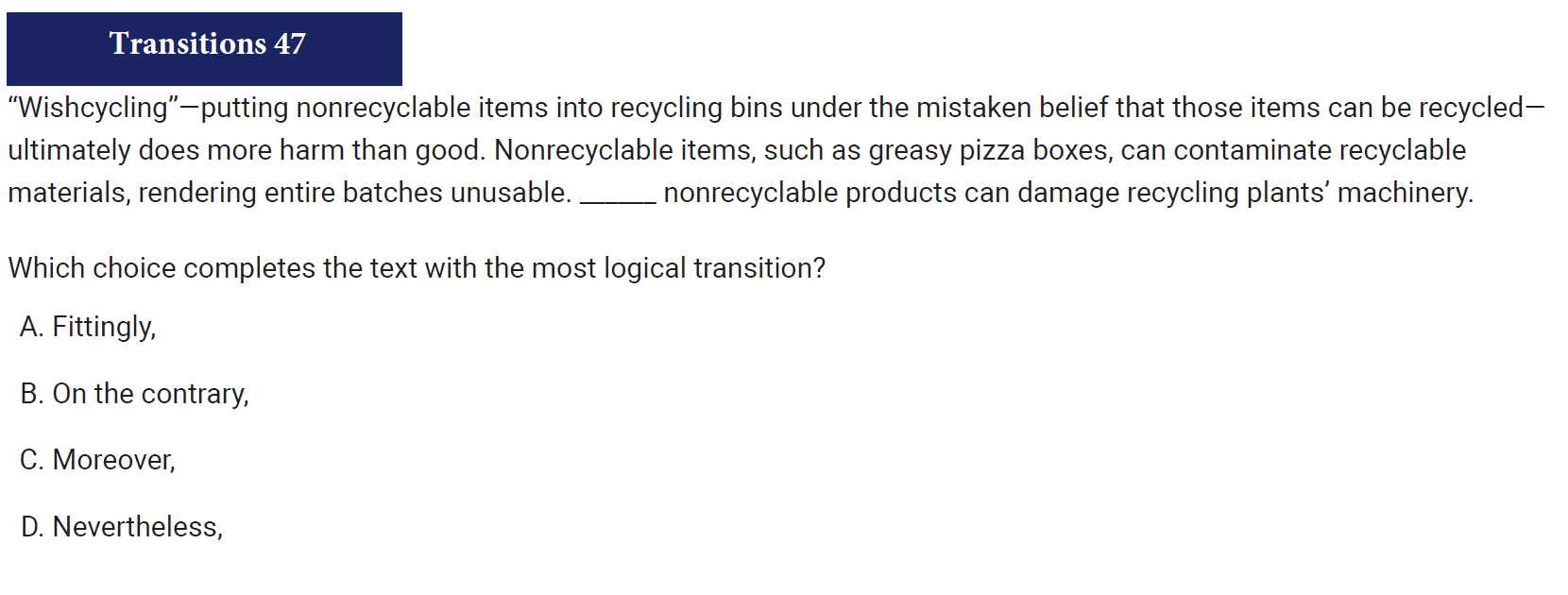
Although it wouldn’t quite match the tone, you may see instinctively how “besides” would make logical sense here, whereas it wouldn’t fit nearly so well in the examples under “General List.”
Causal Sequence
A causal sequence is like a mix between a time sequence and a logical implication (our next category). The difference between a causal sequence and a time sequence is that the emphasis is on the fact that something made something else happen, rather than just the time order. The difference between a causal sequence and a logical implication is that the causal sequence has to be in time: the causing happens. But you don’t have to worry about them testing whether you can recognize the difference between a causal sequence and a logical implication.
Consequently
Hence
Therefore
As a result
Thus
In turn
In response
Logical Implication
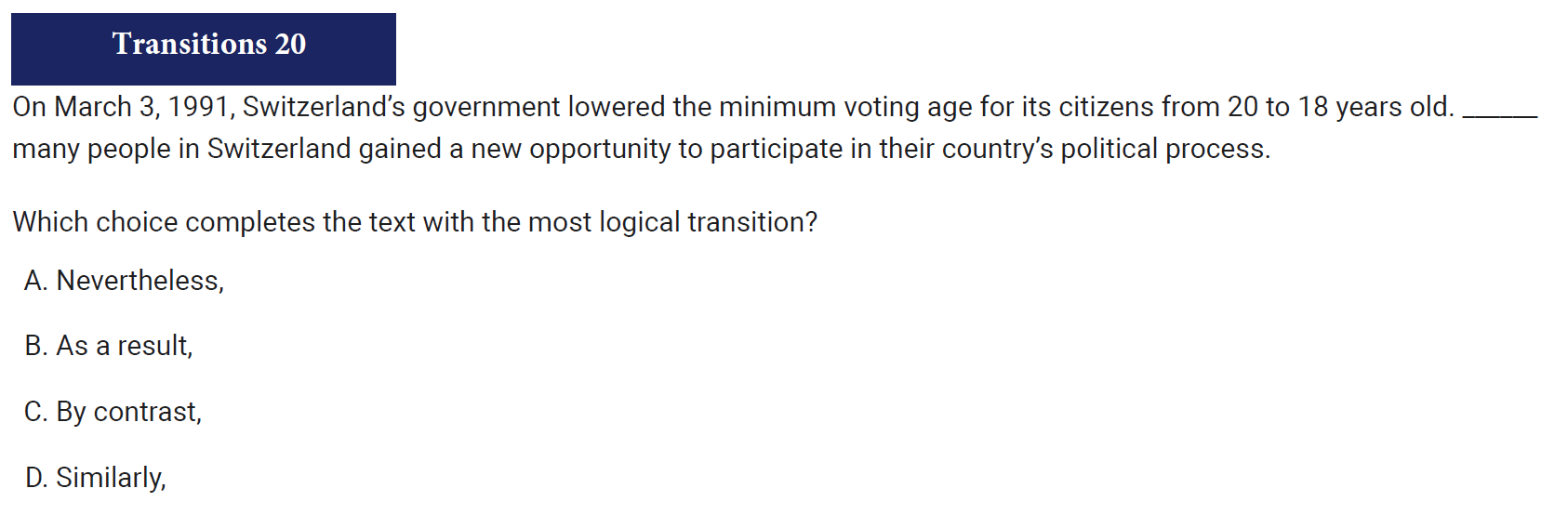
As just mentioned, some instances of logical implication are very close to some instances of causal sequences. In other cases, logical implication is something more like “as you might infer” or “as you can you see makes sense.” “Accordingly” and especially “fittingly” lean in this direction. Notice also that logical implication is the overall organization principle of most Inferences questions on the SAT.
Consequently
Hence
Therefore
Thus
To that end
For this reason
Fittingly
Accordingly
As such
Actions, Goals, Plans
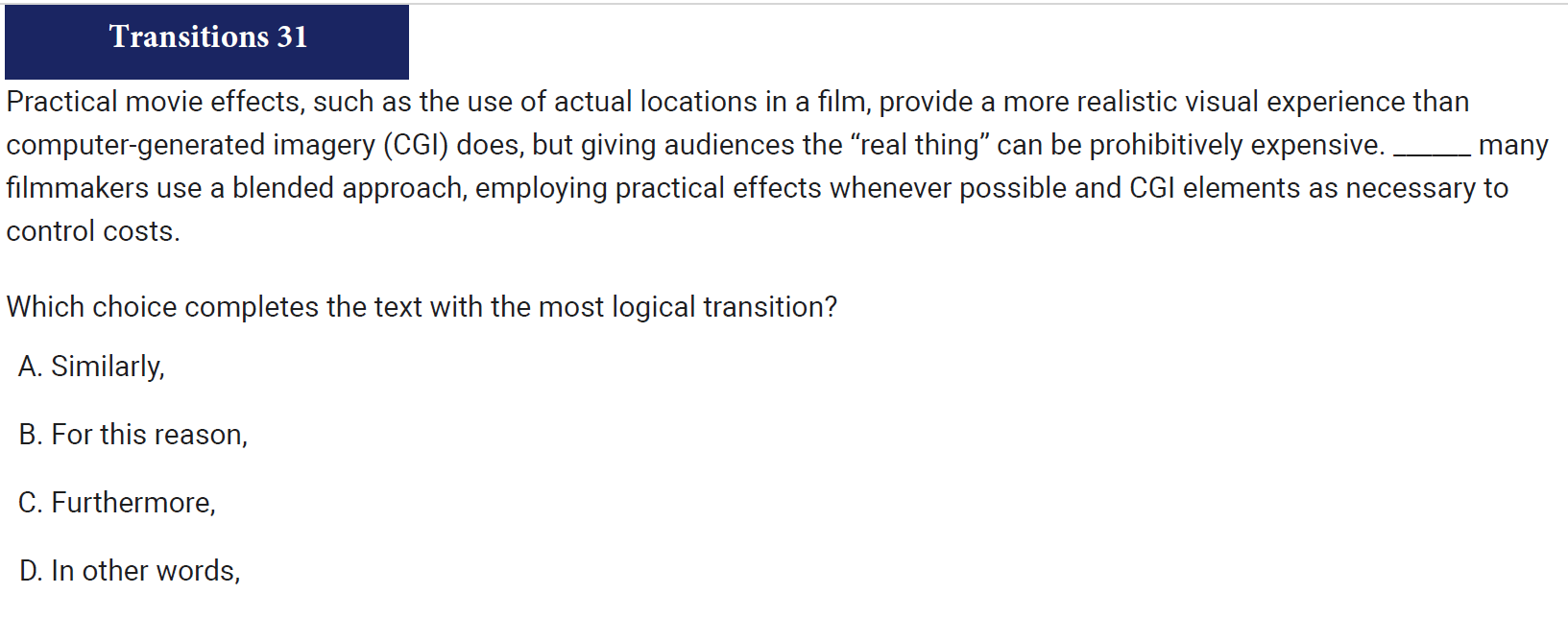
This category is distinct in that it has more to do with the topic of a paragraph—human plans or intentions or actions—then to do with its structure. Like time, human agency is a central enough part of our experience that it has its own transition words and phrases.
For this reason
To that end
In so doing/in doing so
Ultimately
In response
In the end
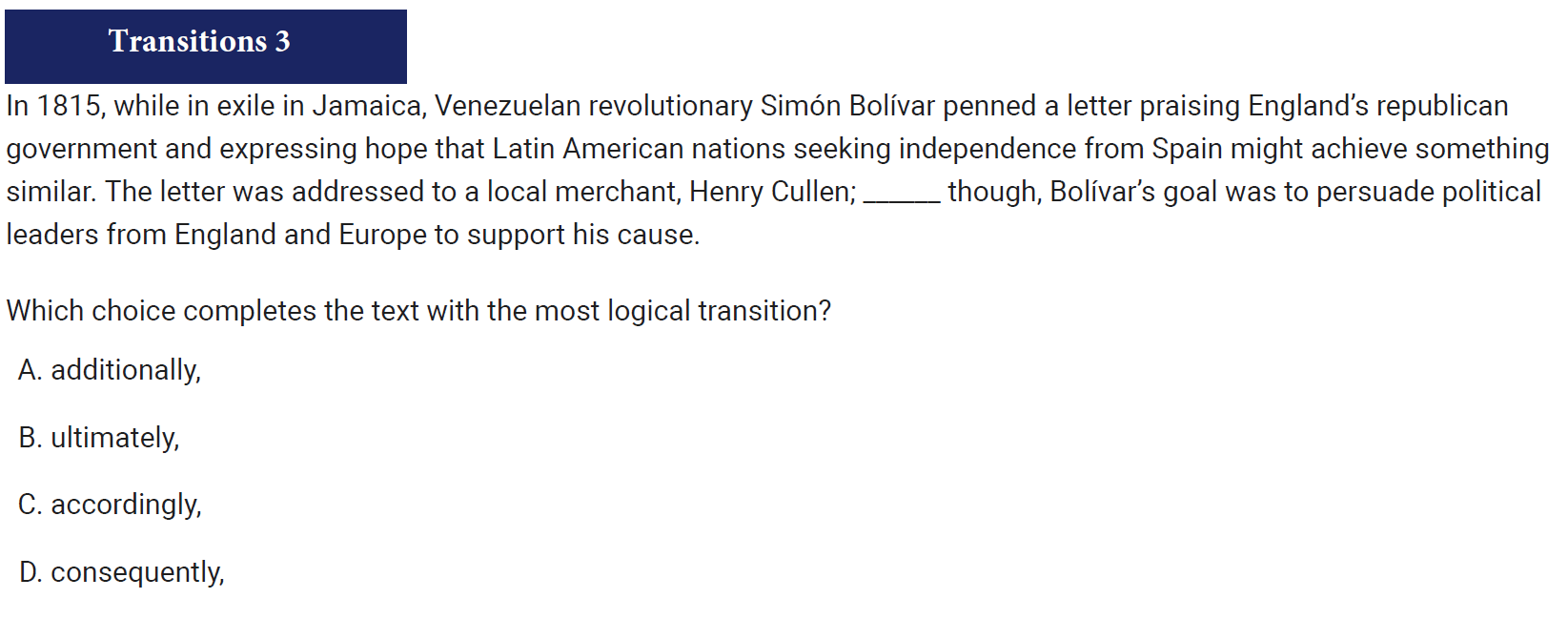
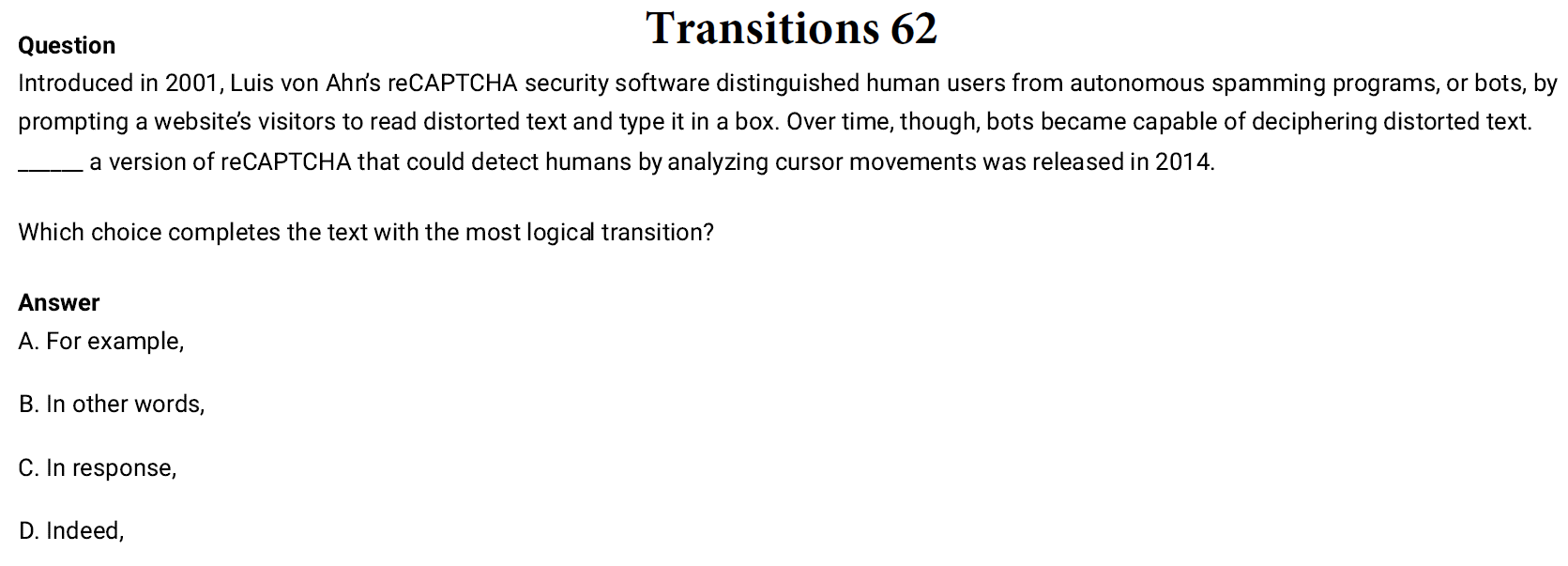
Draw a Parallel
The idea of this type of paragraph is simple: two or more statements are given and attention is drawn to the fact that they are similar. This structure can be used to connect a list of examples, or it can stand on its own.
Likewise
Similarly
Example: There is no reason to lose heart, because all our competition are just as flawed as we are. France clearly struggled in the round of 16; likewise, Spain let in a goal against Belgium when no one was expecting it.
Give Examples
This category and the next two are all closely linked. They all involve making a claim and then building on it in some way. If we were trying to be perfectly accurate to our language, these three categories would have somewhat blurry boundaries between them. However, the goal here is to be accurate enough to give you some reliable footholds for the test, so we keep them separate. But I recommend considering how these three categories are interlinked or how some words from one could fit decently well in another.
For instance
For example
Specifically
In particular
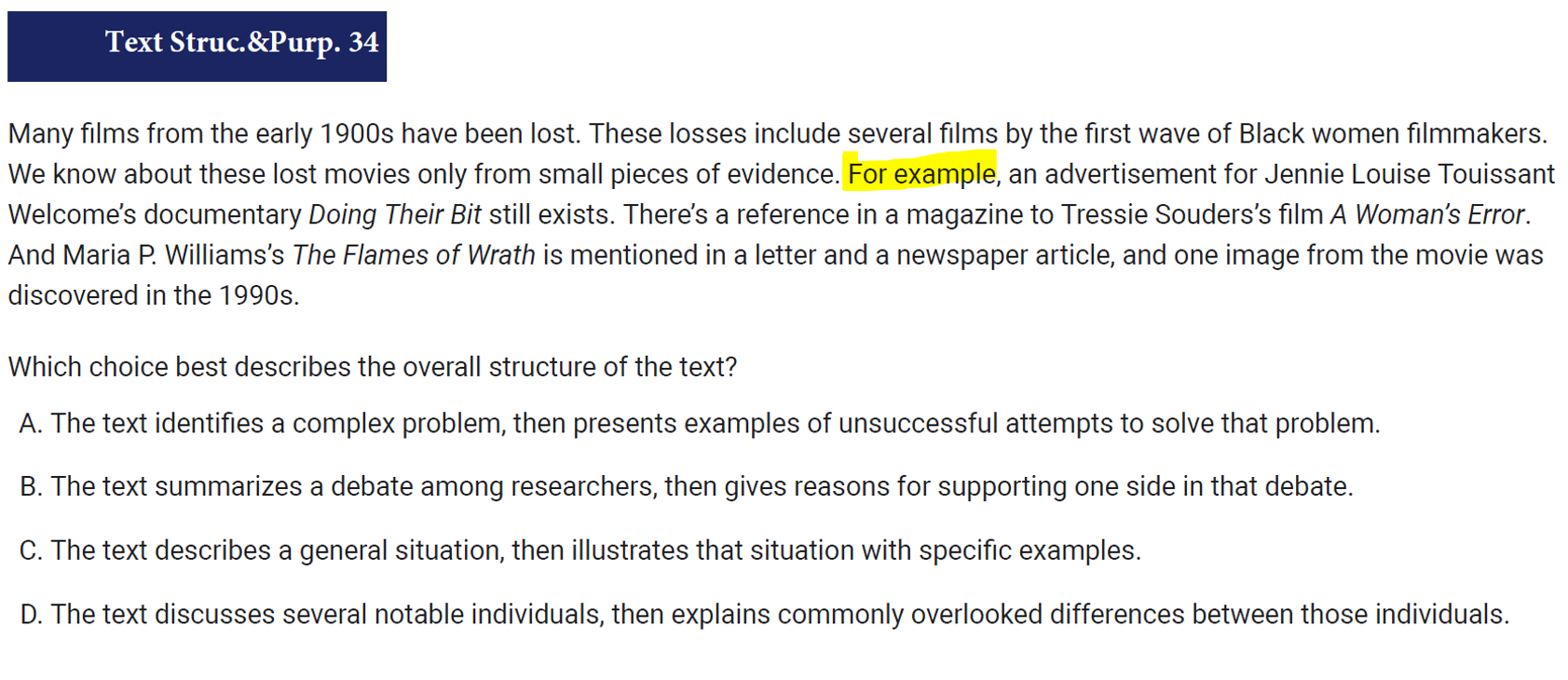
Answer here. Notice that in Text Structure and Purpose questions, just as in Transitions questions, identifying the type of paragraph is at least a partial giveaway. In this case, though, multiple answers choices are compatible with the highlighted “for example,” and you need to read further details of the paragraph to determine which is correct.
Clarify/Restate
This transitions typically do for multiple sentences what a colon could do within a sentence: they connect two ways of saying the same thing. The restatement may be simpler than the original, more complicated than the original, or spelling out what was merely referred to in the original.
That is
In other words
To be exact
In so doing
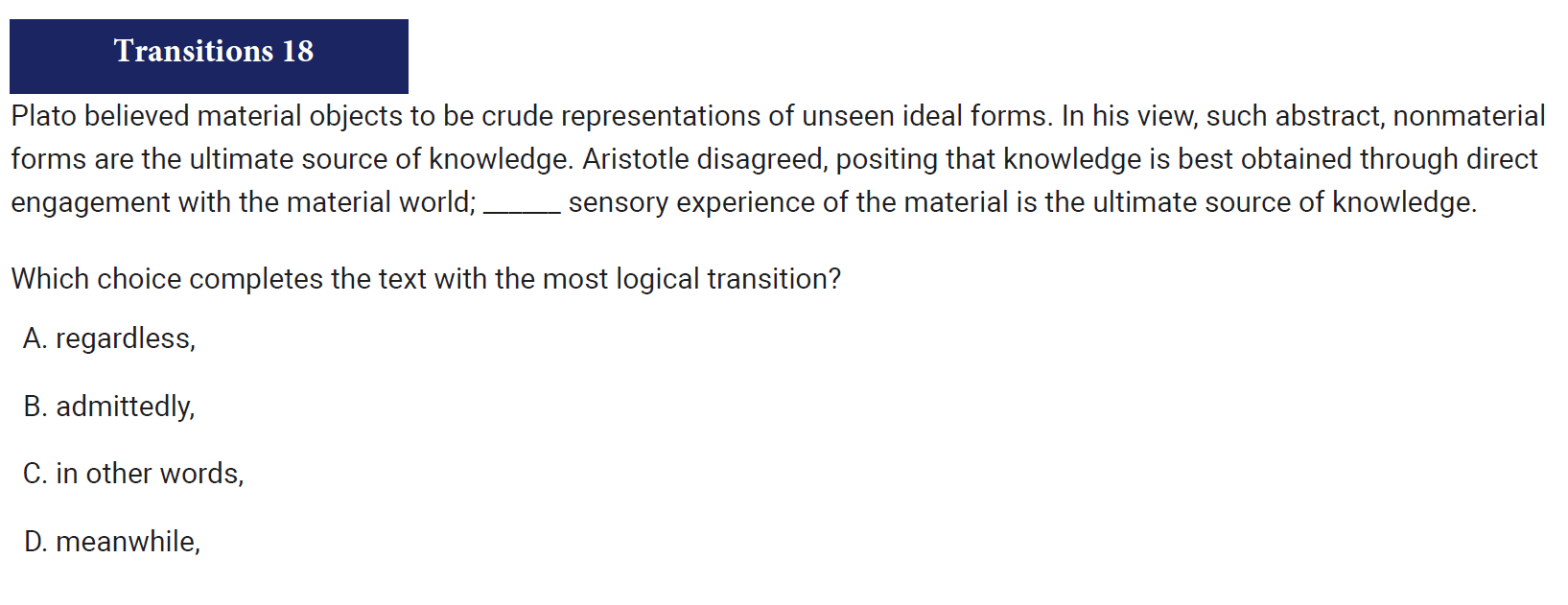
Emphasize/Give Reason
This list is a good example of why we’re not looking for synonyms. “In many cases” is obviously not a good synonym for the other two in this category. However, it is often used in structurally similar paragraphs—those that make a claim and then emphasize or give a reason for it.
Indeed
In many cases
In fact
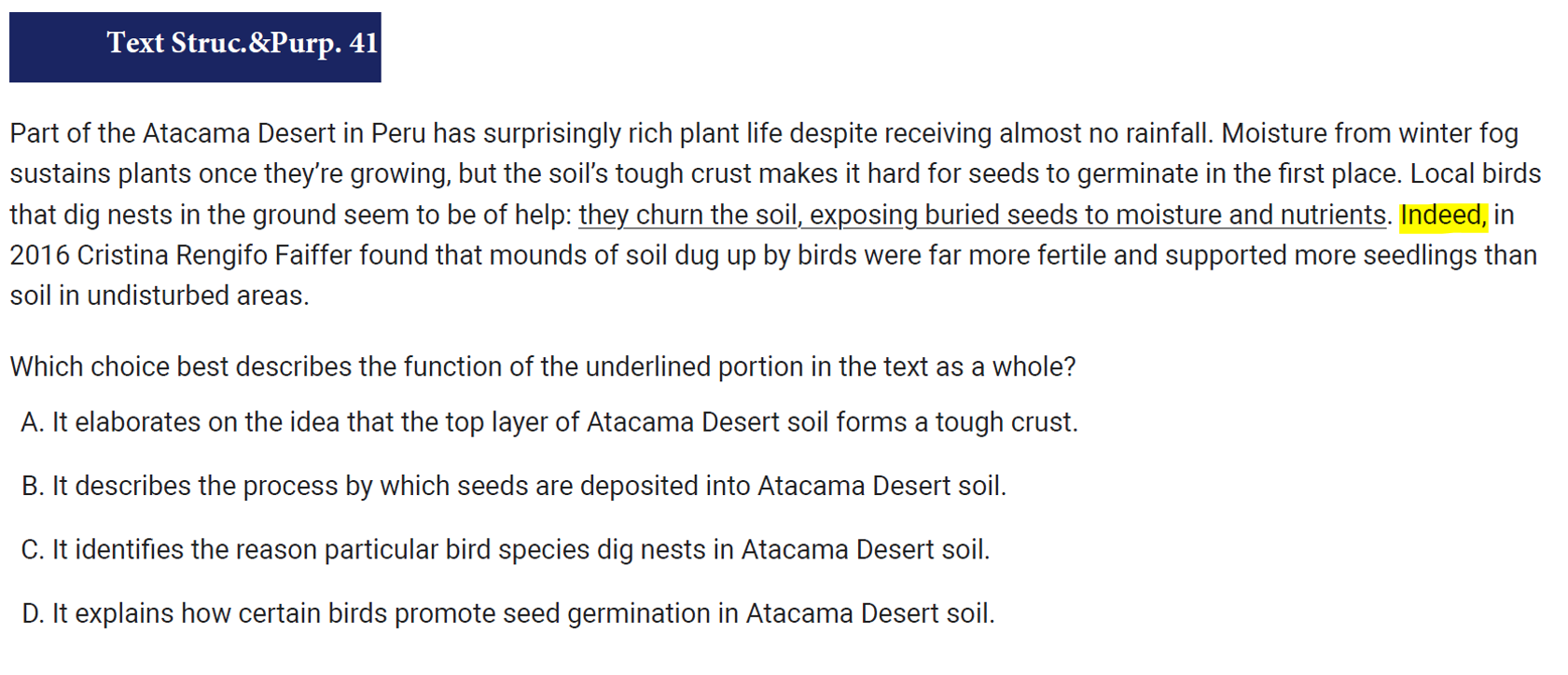
Here the transition word is not in the underlined portion, but it is still relevant to understanding the paragraph and the underlined portion. Answer here
Emphasize a Negation
In some cases, we start with a claim that’s a negation—a claim that denies some other claim (“The Moon is not made of green cheese”)—and then emphasize that negation (“On the contrary, it’s a giant rock”). We can usually use the regular Emphasize/Give Reason transitions for this, but we also have available to us special transitions that only work if you start by negating something.
Rather
On the contrary
Instead
Indeed
In many cases
In fact
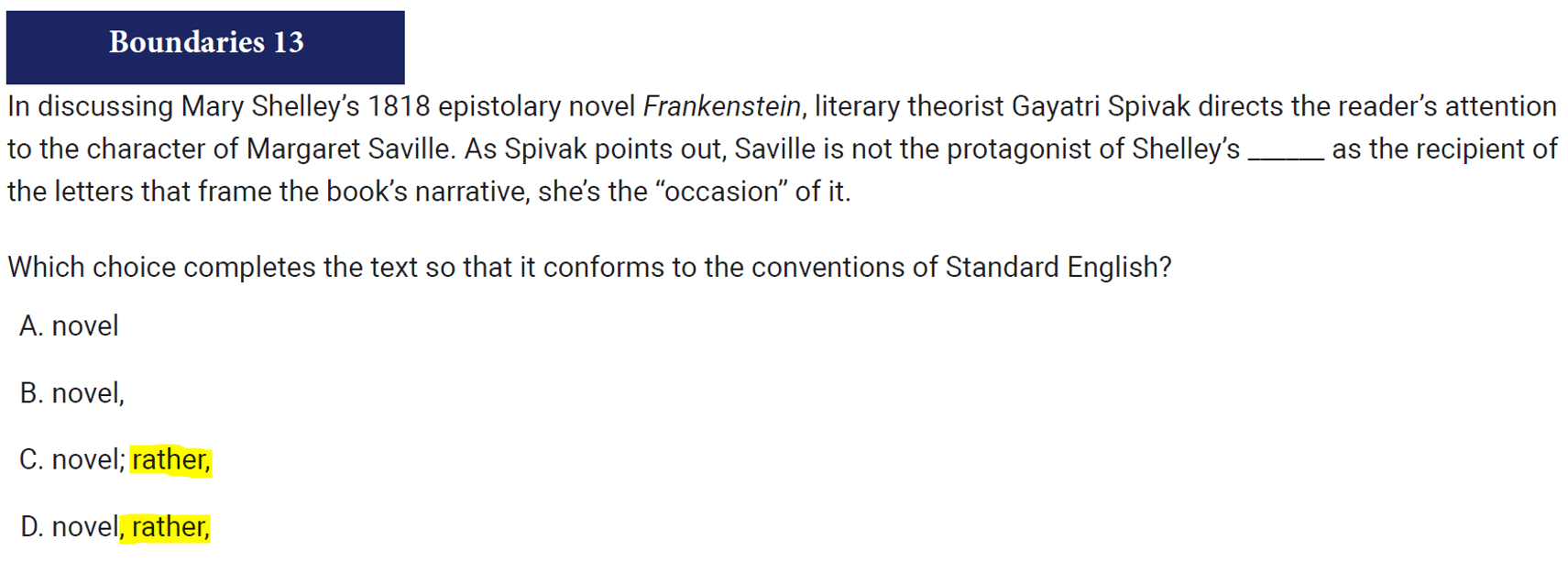
Ok, I’m still kind of giving away that the answer is either C or D. If you’re not sure about which, check out Question Type 1 in this article. Answer here
Contrast Appearance and Reality
This paragraph type tends to involve first a description of how things seem on the surface or how someone views a certain situation. Then, it turns to a description of how things really are. This category differs from “Emphasize a Negation” in that there doesn’t need to be any hint of negation before the transition. It differs from “Changing Direction” in that the transition already tells you what kind of contrast is being drawn between the earlier and later parts of the paragraph.
Actually
On the contrary
In fact
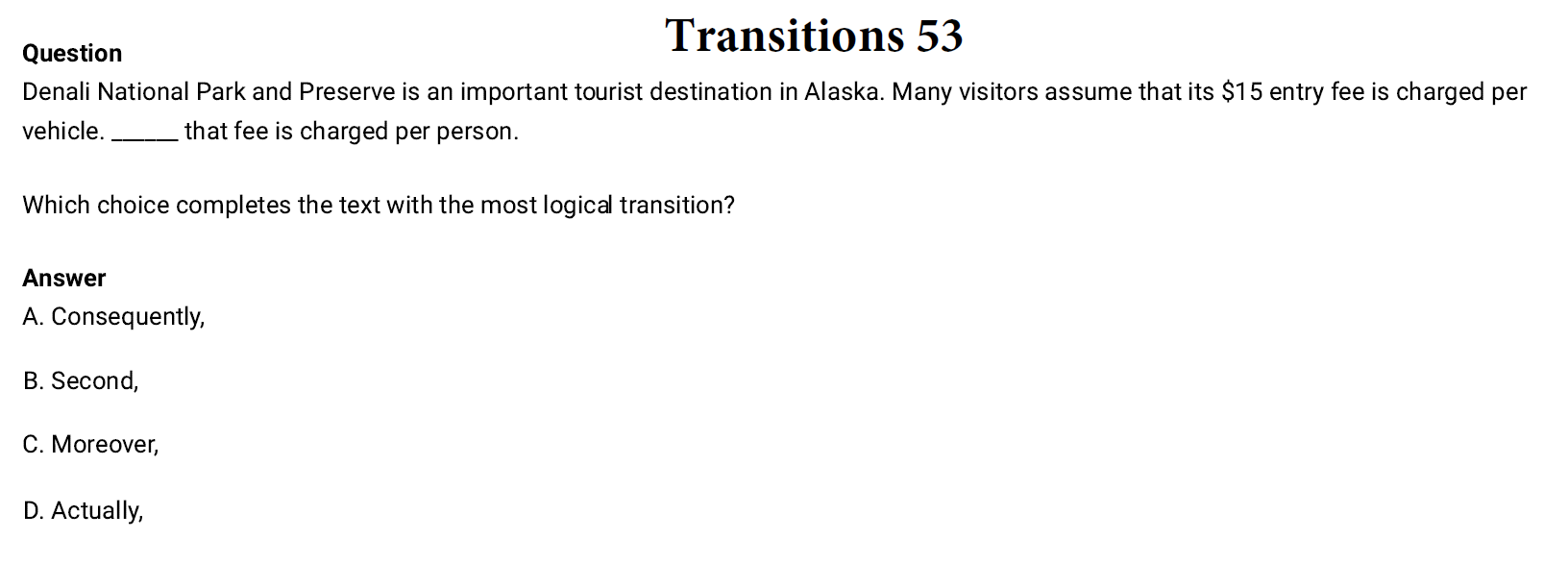
Putting on the Brakes
This paragraph type is sometimes close to the next one. We make a claim and then qualify it in some way or pull back in some way.
Still
Granted
That said
That being said
Admittedly
All the same
Regardless
Of course
Even so
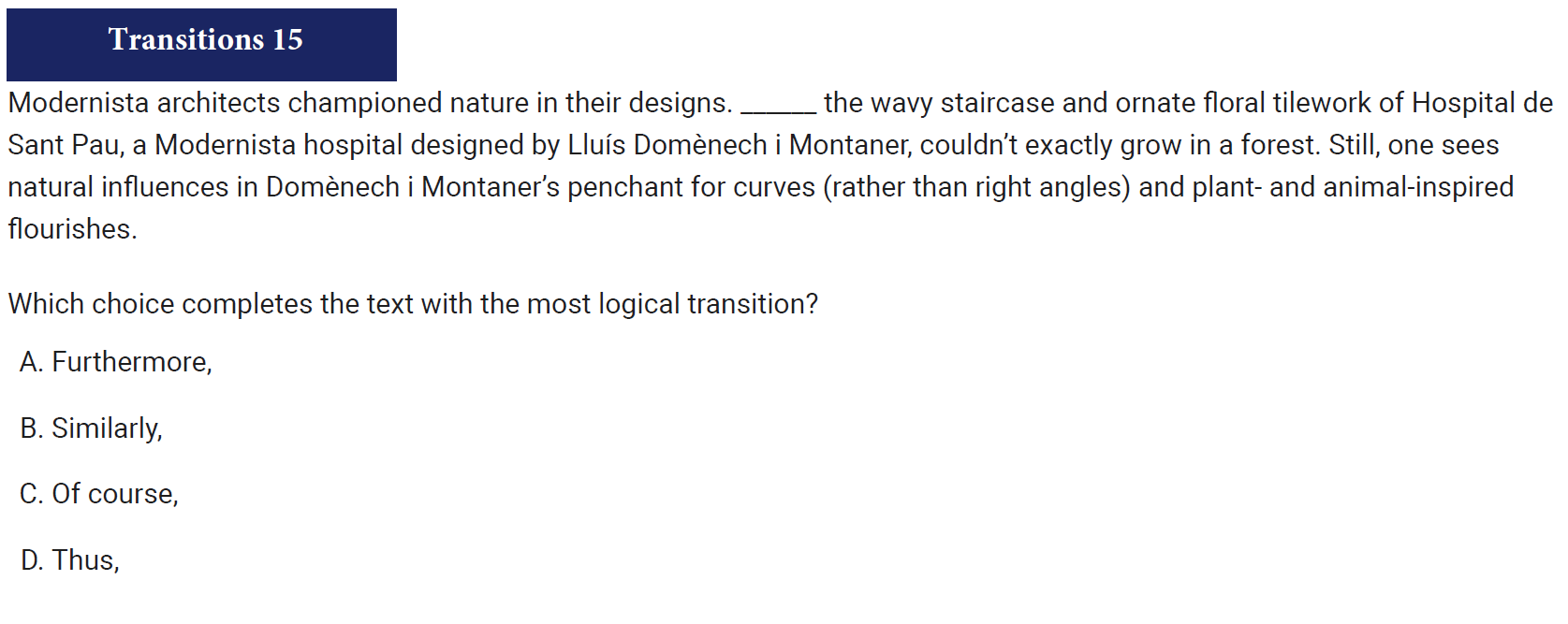
Changing Direction
In this paragraph type, one we’re very familiar with (and one that comes up a lot in the answer choices), we say something and then say something else that significantly contrasts either with the first thing we said or with its typical implications (that is, what we’d expect based on the first thing we said). The common theme in Reading/Writing questions of changing how we think based on research comes up frequently in paragraphs with this structure.
However,
Nevertheless
Nonetheless
Though
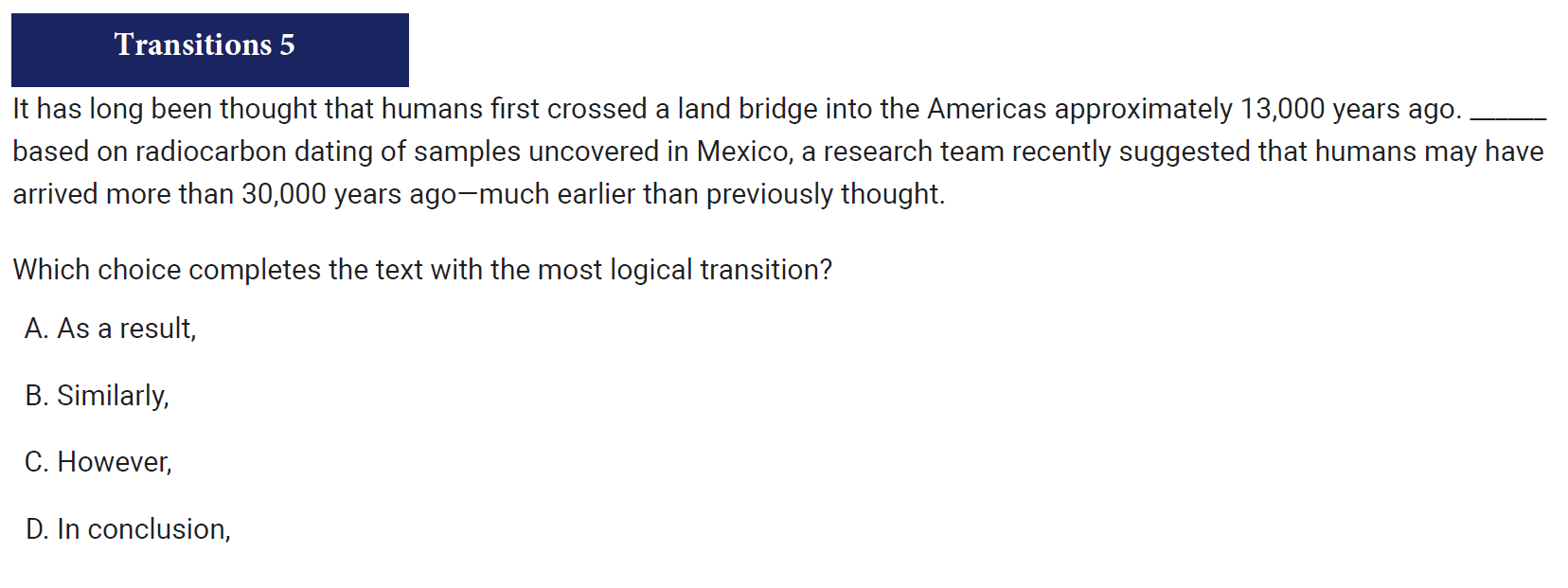
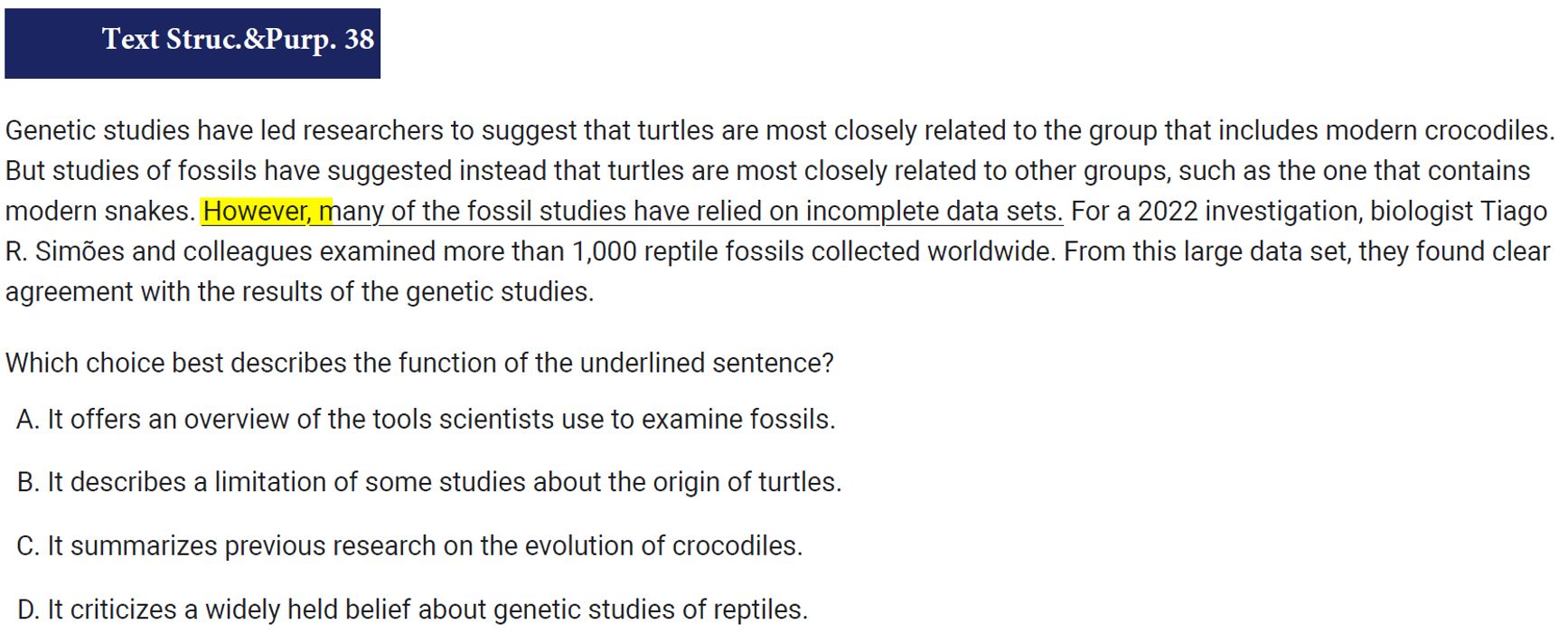
Answer here
Finding Common Ground
Here, after giving a list of some kind, or considering competing claims, we say some commonality between the claims or things we mentioned, as in the example above. Here “regardless” is effectively short for something like “regardless of which side you take,” whereas in the previous category it means something more like “regardless of what I just said.”
Ultimately
Regardless
In any case
In the end
The example here is an Inferences question whose structure includes Finding Common Ground.
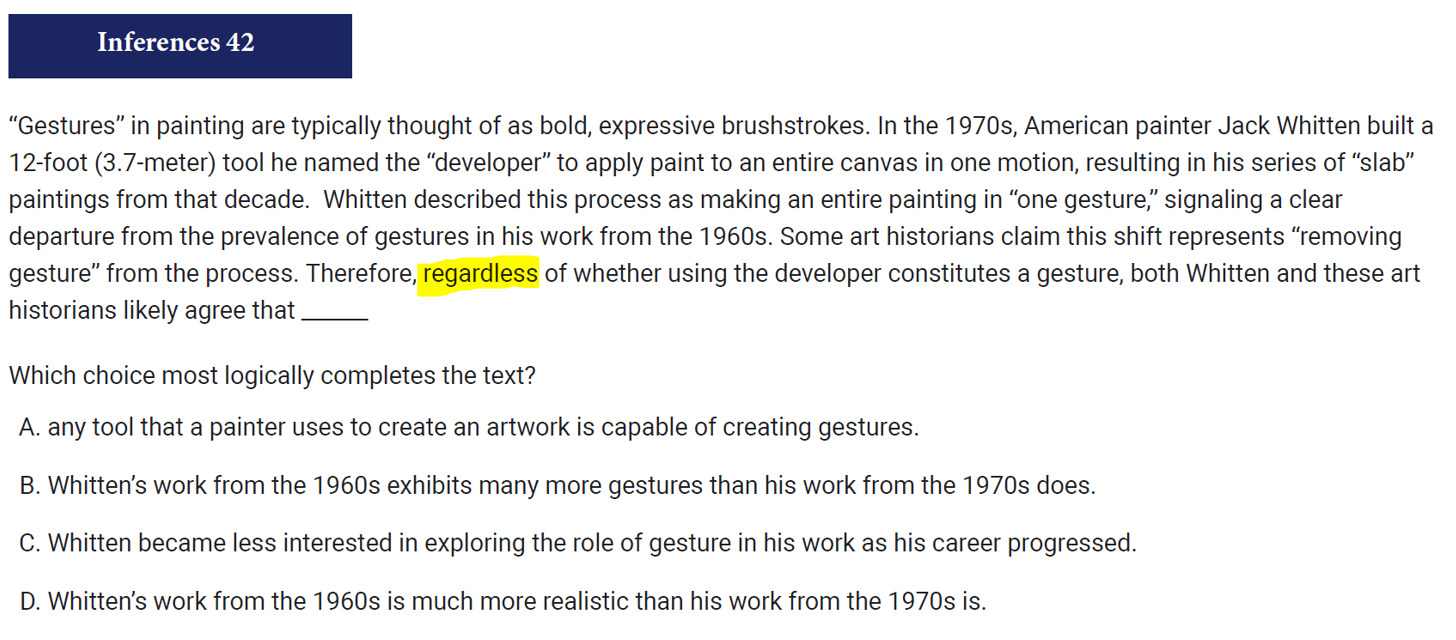
Like almost all Inferences questions, the paragraph has an element of Logical Implication, but the implication is about the common ground between the two options. Answer here
Summing Up
Some paragraphs, whether they start with a list or not, end with a summary.
Ultimately
In sum
In summary
In conclusion
In the end
Example: I’ve been with the team for years, and I’ve never missed a day even for being sick. I’ve put in long hours and gotten results when we needed them. I know everyone on the team, and we work well together. Everyone respects my capabilities, and they know that I respect theirs. In summary, I’d be a great candidate for associate manager.
How to Figure Out Which Category Applies
There won’t be too many close calls in this section—if you know all of the types of paragraphs, you’ll just need to read carefully and understand what’s happening in order to see a given paragraph’s type. One possible close call is when you have to consider certain parallels that express differences. Here’s an example of that:
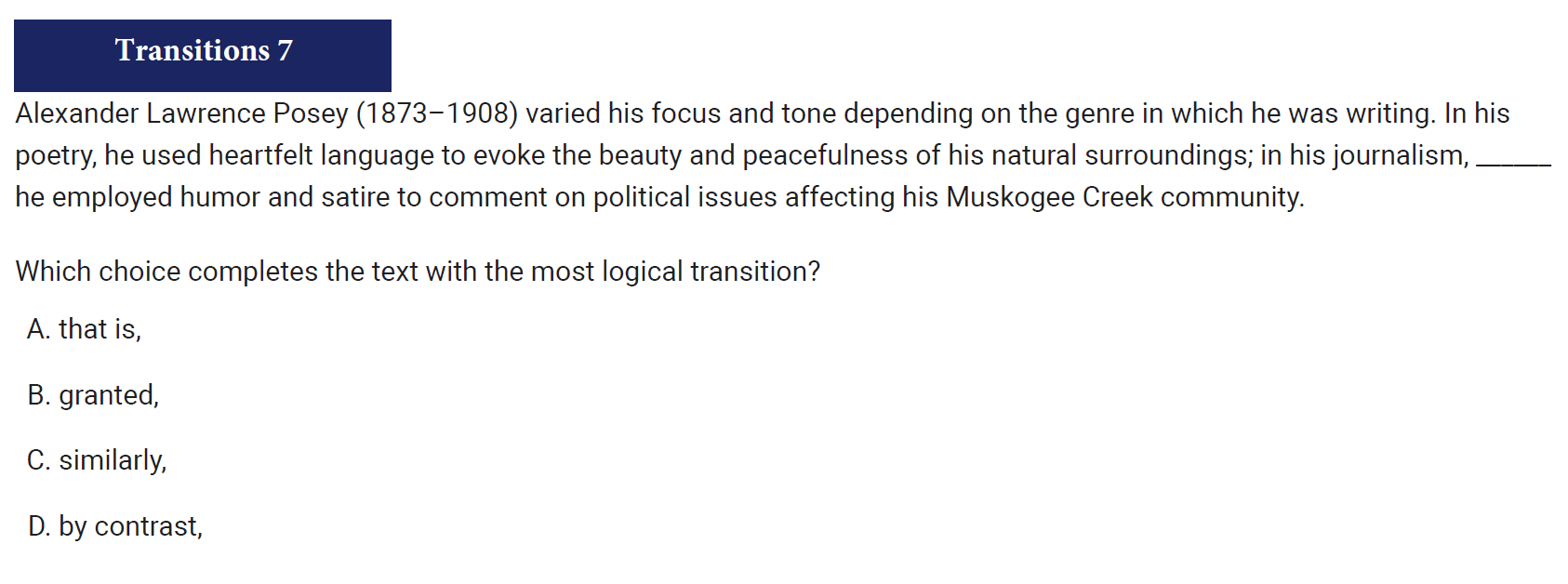
How can we decide whether C or D is appropriate here? The two independent clauses in the second sentence seem to express a parallel: in both cases Posey is doing the thing that the first sentence says he does. But the trait described in the first sentence has to do with him doing contrasting things in different contexts.
This one comes down a bit to convention—in essence, a tendency in our language use that easily could have been different. While the two writing styles are similar in exhibiting his tendency, they are different in content. It’s our convention here to privilege the content of the sentence in which the transition word in used. In that sentence, what is referred to is only the differences between how he wrote in the styles, and not the fact that he was exhibiting an overarching parallel. So it makes the most sense to go with D. We can’t say that putting C in the blank would produce an illogical paragraph. But we can say that, given the conventions of our language, if an author wanted to put “similarly” there, it would be less effective writing unless they changed some of the other words in the sentence. So, if you ever reach a question where two answer choices can make a genuine claim to being logical transitions, the tiebreaker you should use is which would be a more effective choice as a writer, given the rest of the words in the sentence (you can also see how the College Board explains this question using the answers linked at the top, which I will also link here).
But that’s a pretty tough edge case. Most of the time, even on Hard-ranked questions, if you can figure out what’s going on in the paragraph then you can find exactly one answer that logically works.
More Expansive Transitions
Sometimes in writing we use longer transitions that include some of the details of the topic in the transition. When we do this, we avoid having to choose a precise transition word and can improve the flow of the paragraph. Even though this is a way the College Board can add variety to the test, though, they so far have only released two questions like this in the Question Bank, and none on Bluebook practice tests. One of those questions is ranked Easy, and one is ranked Medium. So the presence of these questions isn’t an indication that you should look for these on the hard second module. If anything, adding more words and details to a transition makes it harder for the College Board to design questions that are both more challenging and still objective/fair.
That said, here are the two examples: