SAT Grammar: Form, Structure, and Sense
“Form, Structure, and Sense” questions are about half the grammar (“Standard English Conventions”) questions on the SAT. Standard English Conventions, in turn, accounts for about 25% of the questions in SAT Reading/Writing—typically 6 or 7 of the 27 questions in each Reading/Writing module. In this post I’m going to break down Form, Structure, and Sense questions by type, with the largest number of questions being about which form of a verb to use. This accounts for the first three of the six subtypes here.
Of course, the test won't announce to you what type of grammar question you’re getting. So what we’re doing here is adding some temporary training wheels here to draw the patterns into focus.
Contact me if you see something on here you’d like elaborated on.
All answers to included SAT question bank questions can be found most easily here, using the number at the top. All questions and answers originally come from the official SAT Question Bank, although I’ve added my own numbering for ease of communication. If you want to do the questions and check your answers as you read, I’d recommend clicking the bold link now so you have it ready.
What are Form, Structure, and Sense Questions?
This question category is a bit of a catch-all
It covers everything that is not in Boundaries, which covers punctuation that joins words, phrases, and clauses
In boundaries questions, answer choices differ primarily in terms of punctuation
, . ; : ? — () “"
In Form, Structure, and Sense questions, answer choices differ primarily in terms of wording
Verb form (active or passive, singular or plural, tense, infinitive, mood)
Pronoun choice
Subject of a sentence
But also one punctuation mark, namely apostrophe '
Types of Form, Structure, and Sense questions
Verb Forms
This is the most common question type in this category
Most often, these questions are about the agreement of a verb with a subject, which is mostly about number, singular vs plural
Very often, the answer choices tend to be 3 singular and 1 plural, or 3 plural and 1 singular. When that’s the case, the answer is almost certainly the one that’s not like the others
It can also be about tense:past, present or future
In these cases, if there's a compound verb you can match the tense of the verb outside the blank. Otherwise pay attention to the time order of events in the sentence
You also need to recognize when to use an infinitive, which introduces a verb with "to," or a participle, which ends with “-ing” or “-ed”
Examples of infinitives: "she managed to win a trophy," "I want to go to the moon."
Examples of participles: “Smiling, he walked away,” “They won the title, stunning everyone”
1) Verb Forms: Number
This is the most common of the three verb forms types, and by itself is more common than the other types of Form, Structure, and Sense questions
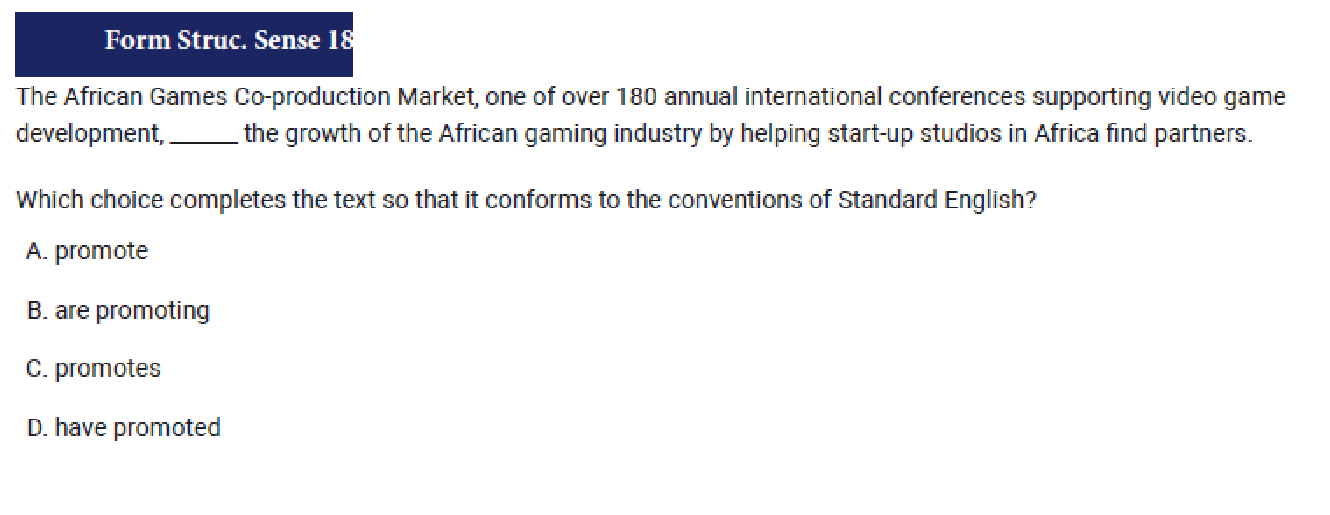
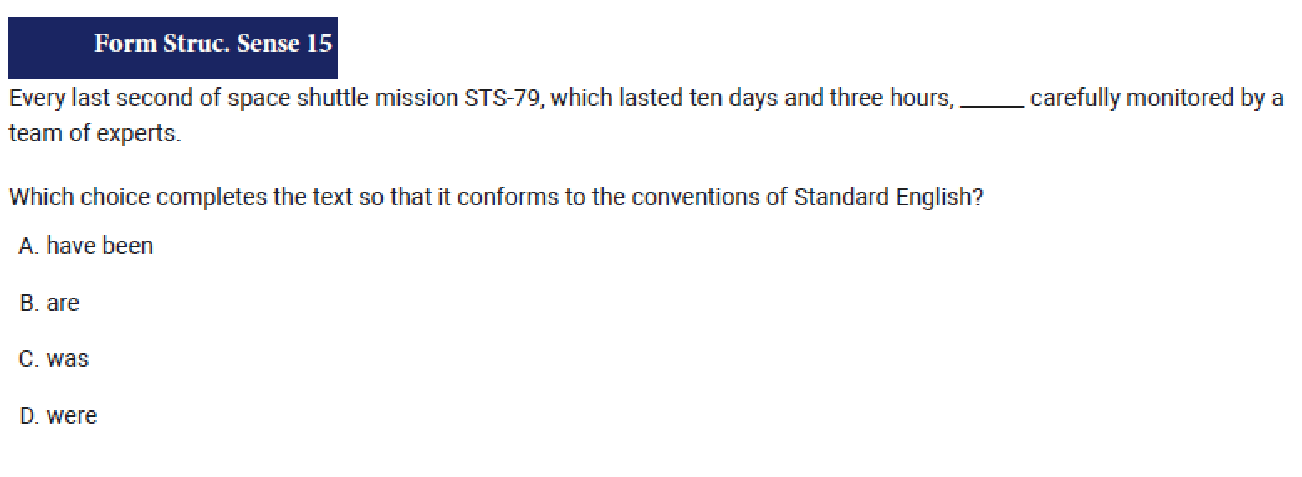
The task is, find the subject of the verb in the blank, and see if it's singular or plural. If the subject is plural (typically ending with an “s”), the verb should be plural (typically not ending with an “s”, or starting with “are” or “were”). If the subject is singular (typically not ending with an “s"), the verb should be singular (typically ending with an “s” if in present tense, or starting with “is” or “was”).
Some plural nouns don’t end with an “s”: children, geese, mice
Some singular nouns end with an “s”: glass, bus
But the test won’t lean too hard into the exceptions, because that would make it a test of knowledge of particular words rather than general rules
In some tenses, verb endings don’t differentiate between singular and plural. But some do. Compare this partial list of tenses:
Simple Present: She runs down the field/They run down the field
Simple Past: She ran down the field/They ran down the field
Present Progressive: She is running down the field/They are running down the field
Past Progressive: She was running down the field/They were running down the field
Simple Future: She will run down the field/They will run down the field
Present Perfect: She has run down the field/They have run down the field
Future Perfect: She will have run down the field/They will have run down the field
Past Perfect: She had run down the field/They had run down the field
Not a tense, but modals: She would have run down the field/They would have run down the field
The same patterns holds if instead of would we use could, or should, or might, or may
See the last point in question type 2, on mood
Here is one of the few really good answer-choice "hacks" on the SAT: if three answer choices are singular and one is plural, then you're almost certainly being asked whether the verb should be singular or plural, in which case it has to be the one that there's one of
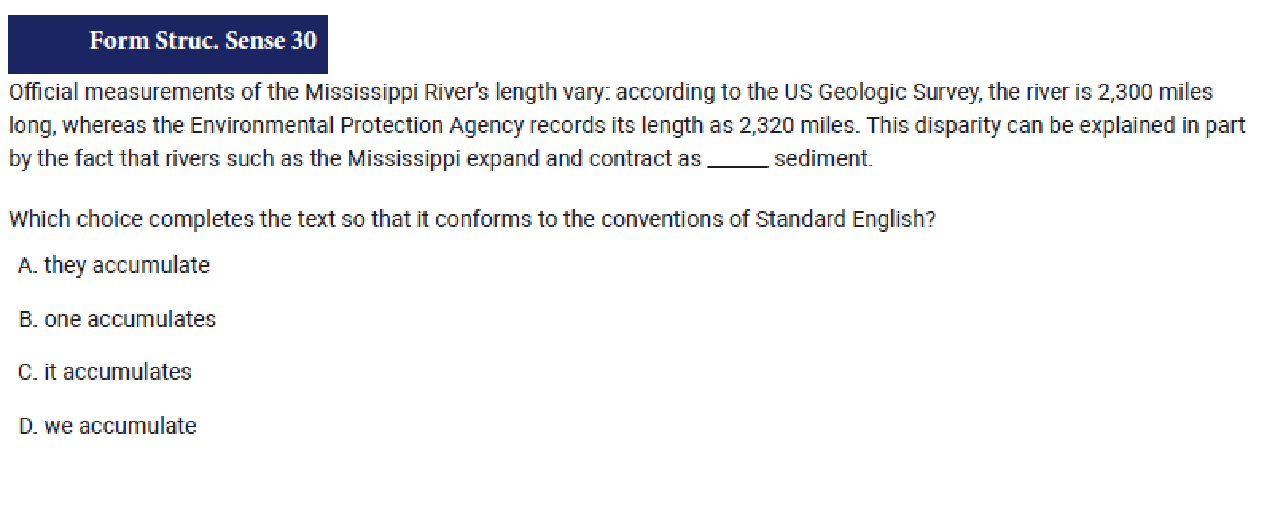
Sometimes there is a pronoun as the subject of the verb. In this case the pronoun needs to match the noun it refers to, and the verb matches that. This is a sort of combo question with the “pronouns” category below.
2) Verb Forms: Tense or Mood
This one is usually a little trickier than singular vs plural
We included a partial list of tenses in the previous section. But what you need for these questions is not to know the tenses in perfect detail but rather to reason about the order of events to match the tenses to that (the questions after provide a good range of what you need to differentiate in terms of tense).
For example, if the passage started in past tense, moves to present tense, and then has a blank with no indication of referring to something back in the past, then the verb in the blank needs to be present tense
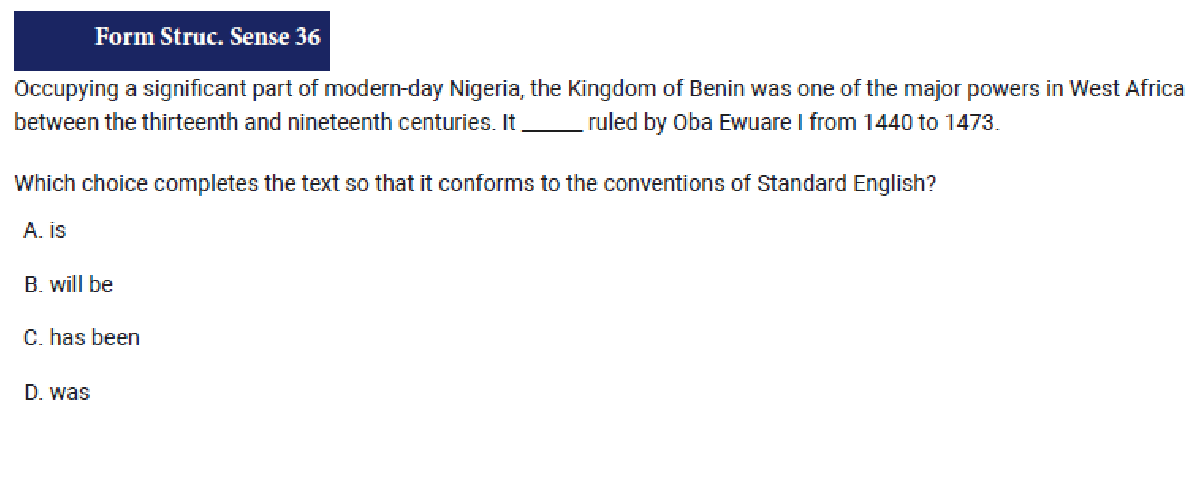
If the verb referred describes an action which you know from context (dates or otherwise) is over, then use a past tense verb
One pair you do need to know the difference between "has been," which implies being open to continuation, and "was," which implies being continuous in the past but now over. You’ll need to use context clues (possibly including dates) to know which is appropriate
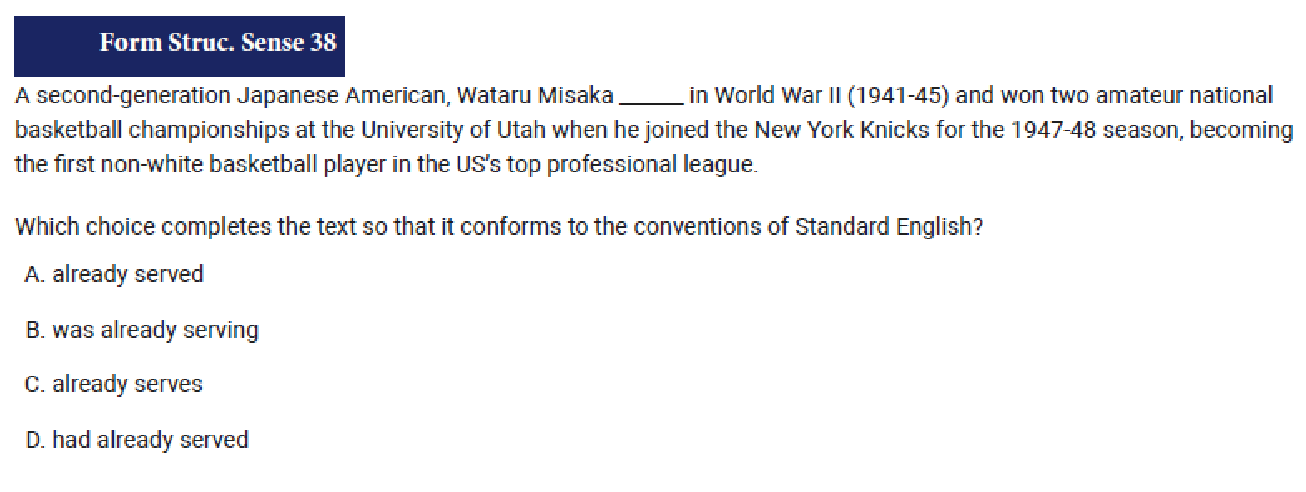
You do need to know that if the sentence or paragraph is already in past tense and a given event is supposed to be in the past relative to that--in the past of the past—you should use past perfect or pluperfect, which puts "had" in front of a past tense verb
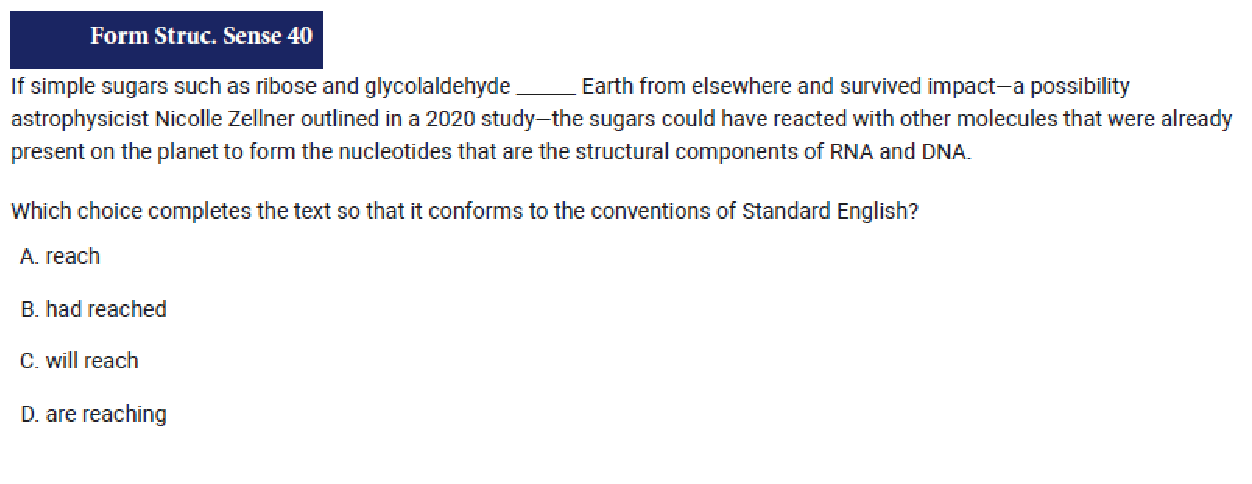
Mood (not as common): If there is a conditional verb outside the blank ("if he had...," "Had they..." "If she were to...", the verb inside the blank needs to reflect that, often with a "would.” These phrases indicate a “mood” other than “indicative (could be “subjunctive” or “conditional” depending on the sentence). But you don’t need to know the details beyond knowing that the phrases just mentioned go together.
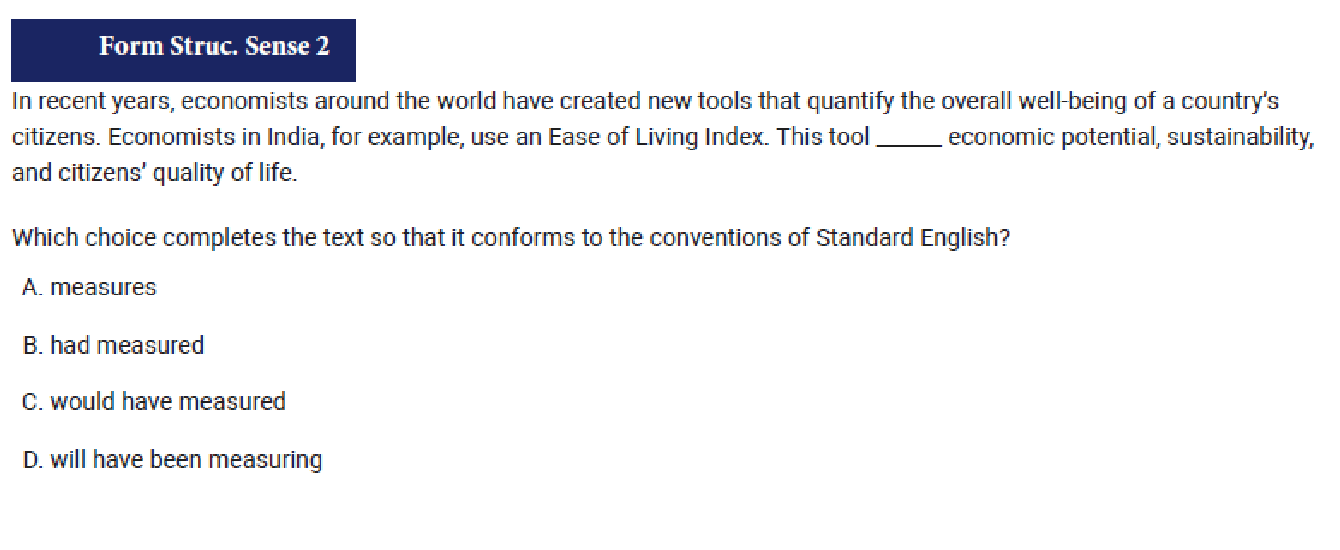
3) Verb Forms: Main Verb, Infinitive, or Participle?
In these questions, typically the answer choices are one main verb, one infinitive, and two participles
Sometimes there is a compound verb, and then you just need to make the verb in the blank match the other verb. Here is an example of that before we move on:
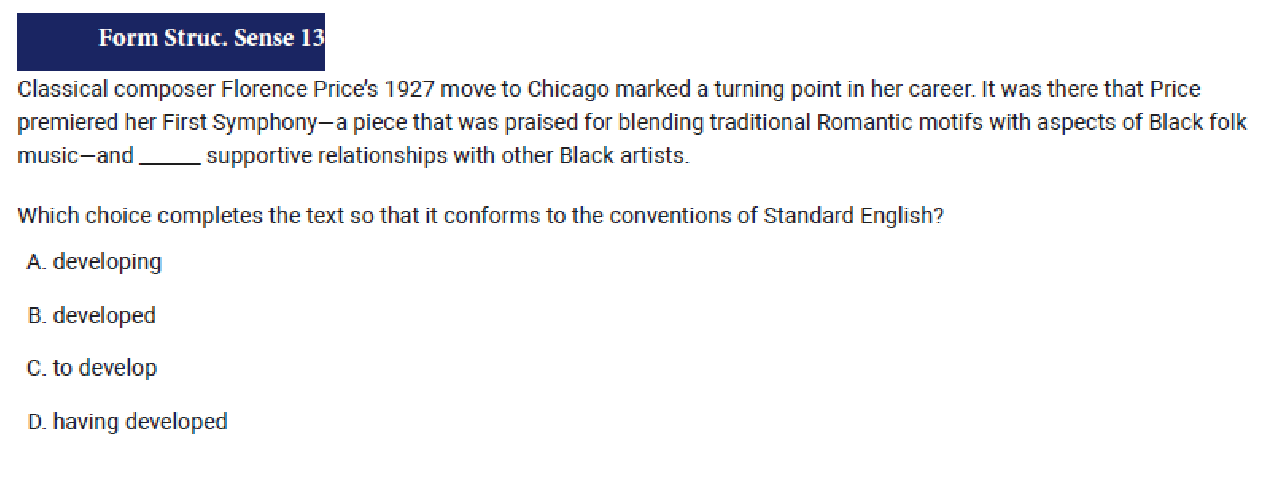
Other times you need to figure out if a main verb is needed from the words and punctuation around the blank. Let’s look at the other two constructions to see when they are used instead of a main verb
Infinitive: to + verb
An infinitive doesn’t serve as a main verb. It can come after a noun or verb to complete its meaning
"She was able to overcome great challenges."
"They are the team to beat in this tournament."
Can also reflect intention, being short for "in order to"
“I went home to get changed.”
Use:
If the blank is right after another verb with no “and,” or after a noun which can’t serve as the subject
If a verb reflects the intention behind a previous verb (“went home to get changed”)
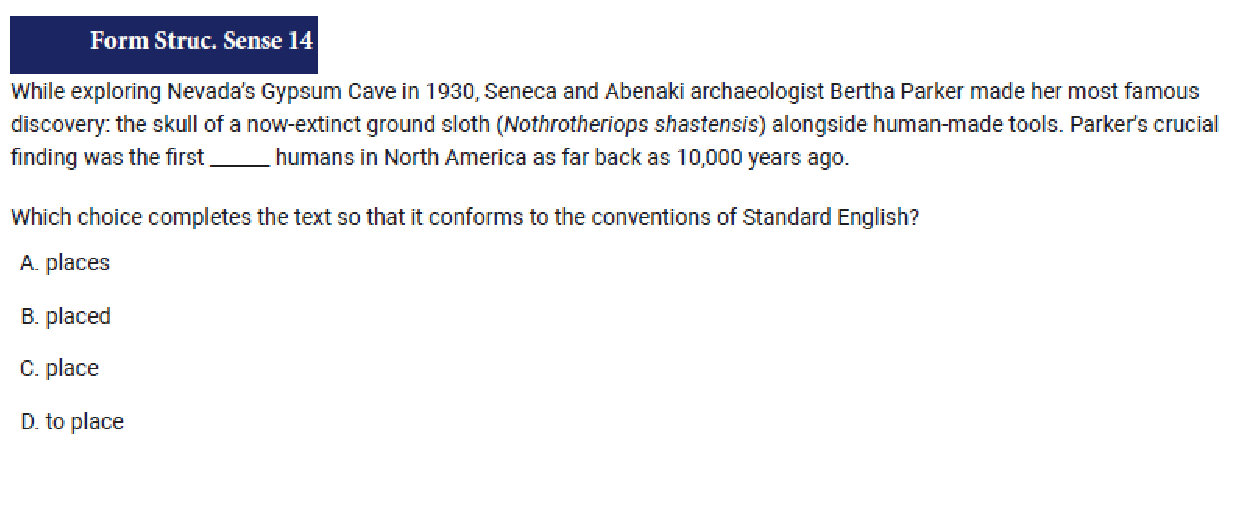
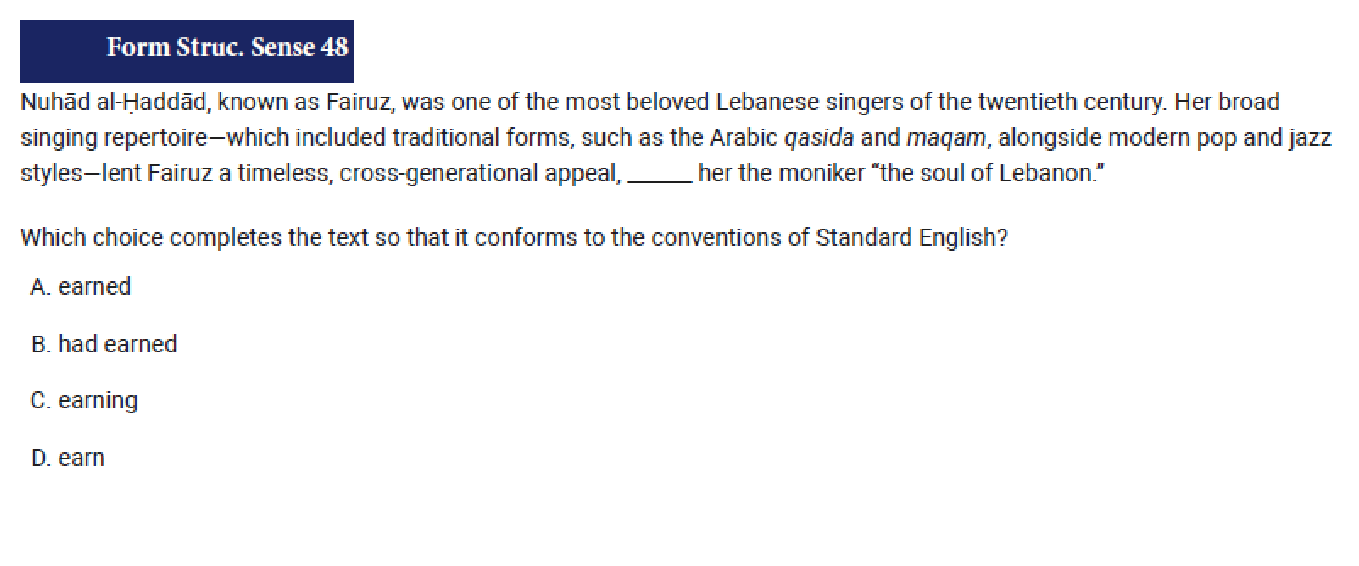
Participle: verb + -ing, verb + -ed
Can't be a main verb unless it has a form of "is" in front: "is," "was," "were," "are," "will be," "will have been"
Examples in the introduction above
Use:
If there is blank at the start of a sentence, with a verb first
If after a comma, there's no "and" or other coordinating conjunction between the comma and the verb
Another sign: use if matching another participle
Differentiating Types of Verb Form questions
We usually can figure out which of the above types we’re seeing, and hence what’s being tested, by looking at how the answer choices differ. The test-makers could blend the 3 different choice just by including a different mix of answer choices, but they don’t do it too often. To understand what is being tested in a verb form question, we can look at the differences between the answer choices.
Do the answer choices differ primarily in singular vs. plural? Then that's what's being tested.
First thing you may notice: 3 singular answers and 1 plural answer or vice-versa; two verbs of the same tense but one is singular and the other is plural
Do the answer choices differ primarily in tense? Then that's what's being tested.
First thing you may notice: there are multiple tenses in the rest of the sentence
Is one of the answer choices a main verb, one an infinitive, and two are participles? Then the question is whether you need a main verb or one of the others.
First thing you may notice: the answer choices look like “very different” forms of the verb
Other Question Types
4) Avoiding Misplaced Modifiers
Some questions have a phrase at the start which determines what the subject needs to be.
Typically, it does this by including a participle, like "running" or "defeated"
This could be a "participial phrase" (which starts with a participle) or a “prepositional phrase” (which starts with a preposition, like "before," "while," or "in") that has a participle in it but doesn't have the noun which the participle is modifying
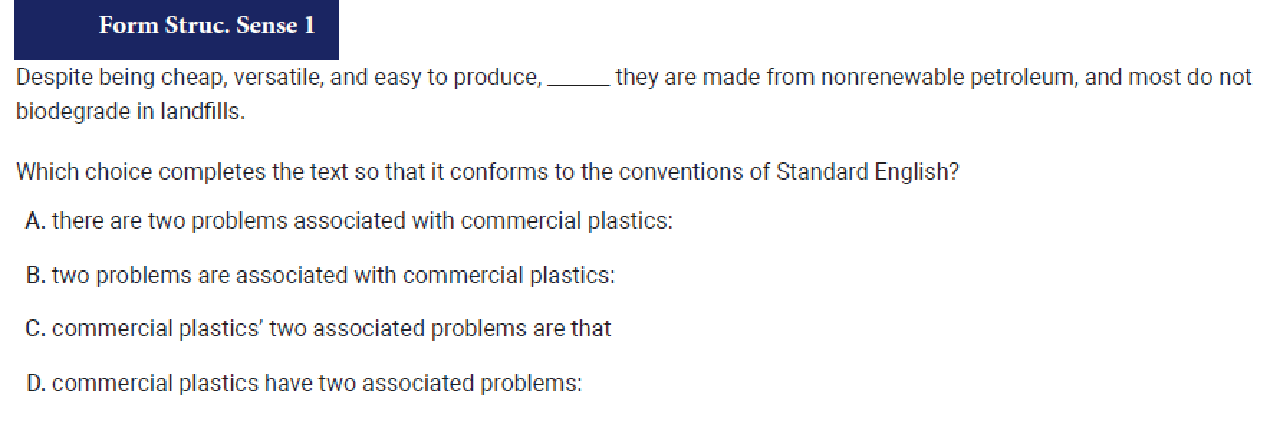
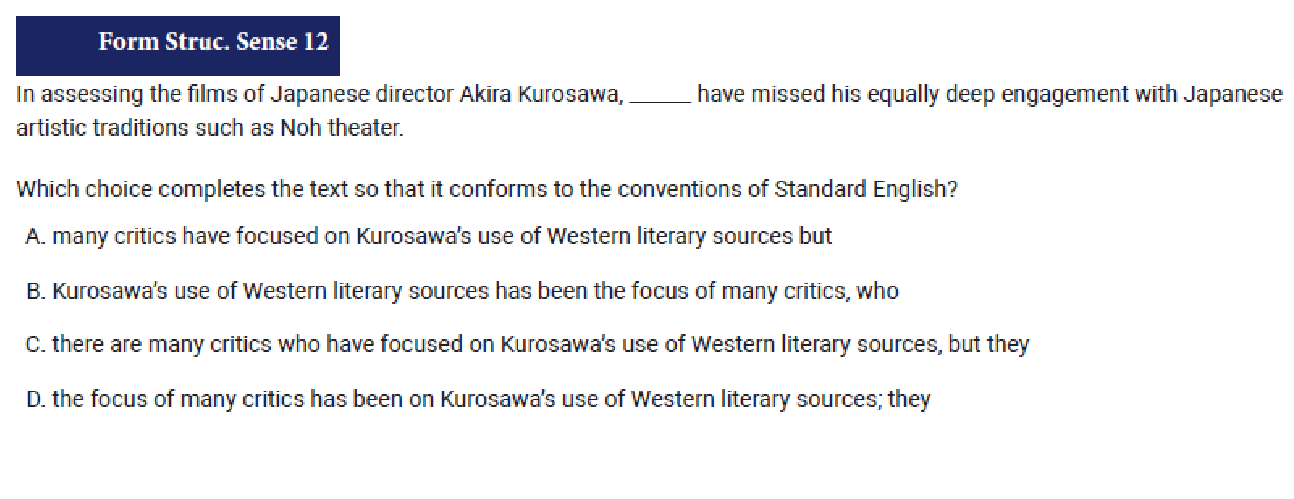
When this happens, the participle always modifies the subject. So whichever noun is described the participle must be the subject of the sentence. Otherwise the modifier is “misplaced.” We can’t move the modifier because it’s not in the blank, so instead we make the thing it refers to the subject of the sentence.
So your job in these questions is usually to choose the subject to match a participle in the phrase at the start. We’ll look at a variant on this, where the phrase at the start fixes the subject but doesn’t use a participle, in a moment.
4b) Avoiding Misplaced Modifiers, but Modifier Has No Participle
A participle is just one way to figure out which thing a phrase modifies
Other times, we can do it from context
Feeling green with envy, I couldn't bring myself to root for my friend up there.
Green with envy, I couldn't bring myself to root for my friend up there.
Whether or not the participle "feeling" is present, it's clear that the modifying phrase at the start refers to the subject.
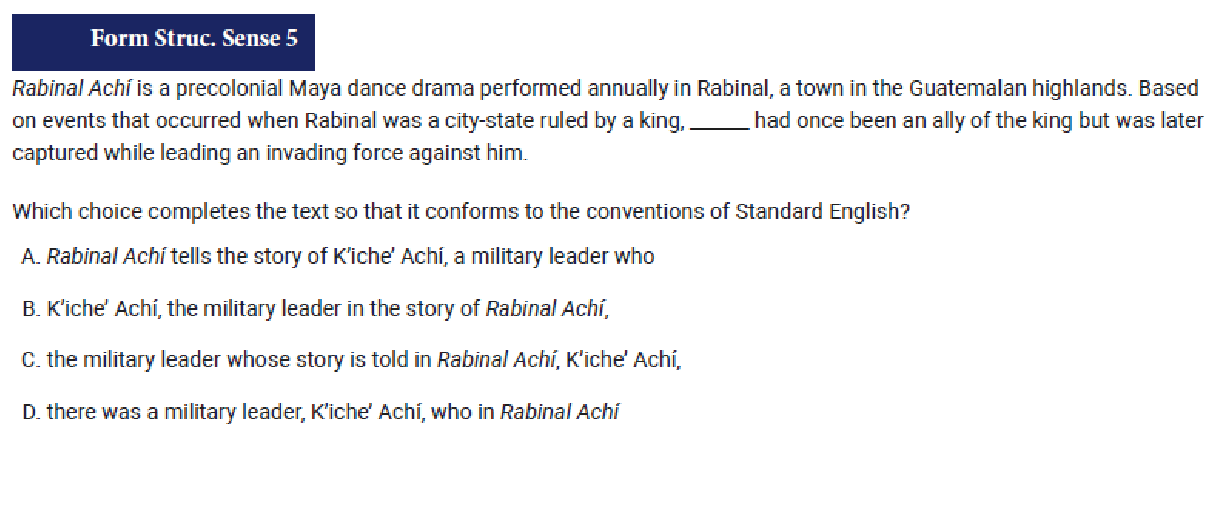
Another common phrase type that picks out a certain subject is an appositive phrase, which re-describes or clarifies something about a subject. The question below is an example of this.
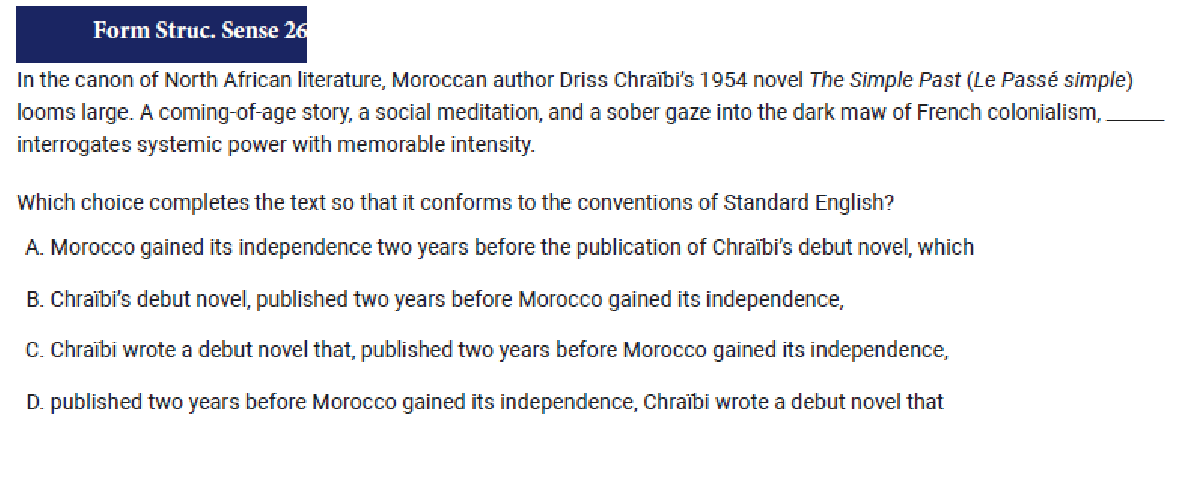
The phrase at the start still forces the sentence to have a particular subject, but it doesn’t refer to the subject with a participle. Instead, it re-describes the subject. We call this an appositive phrase.
5) Apostrophes for Nouns and Pronouns
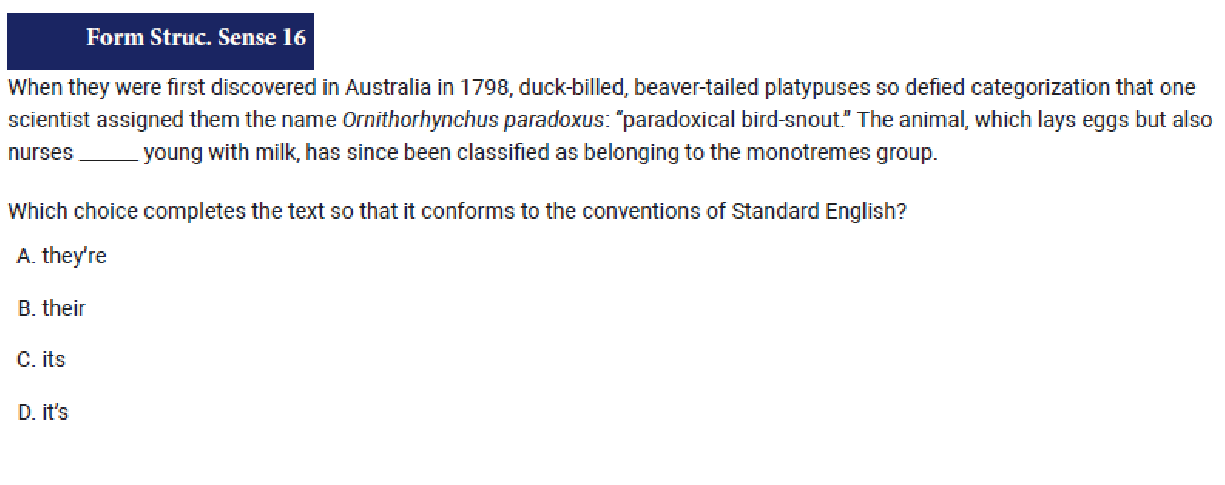
The rules for how and where to use apostrophes are clear and consistent, and maybe only the challenge of plural possessives (rule #4 below) is especially tricky. However, “its” vs “it’s” can be really hard to remember, and beyond that we have some really bad habits as an online society when it comes to overusing apostrophes on plural nouns. So this is one area where you can’t necessarily afford to trust your instincts.
1. Very few plural nouns have apostrophes
I want to get all A’s and B’s in the fall
On Fridays and Sundays I go to the movies
[If it helps, think about how weird it would be to write I’m going to the movie’s. Now try to extend that instinct to other words like Fridays, Sundays, etc.]
2. Possessive nouns have apostrophes, but possessive pronouns do not
This bag is Jalen’s even though it has Mikal’s jersey next to it.
I know because his name is on its side. My sleuthing is pretty effective.
The apostrophe’s role in English is one of our language’s great difficulties. The period’s role is much clearer. I know where to put periods.
3. When do pronouns have apostrophes? When they’re in contractions
We’re finally ready, which is good because it’s time.
The water fountain? It’s over there, but its pedal doesn’t work right now.
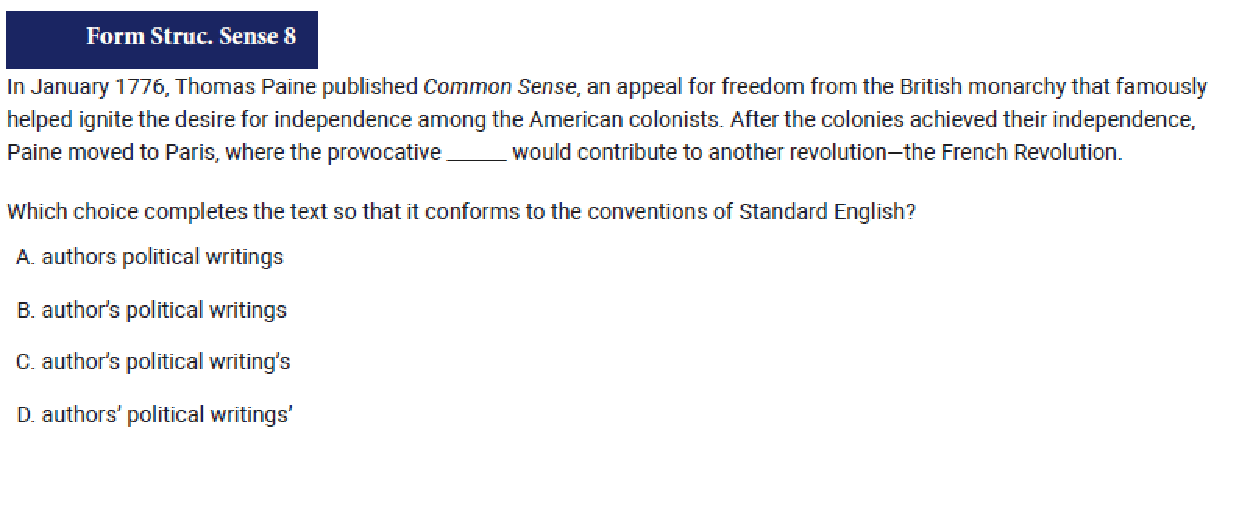
4. Possessive plurals do have apostrophes, which go after the “s” except for irregular plurals
On the family’s game night, it was parents against kids. The children’s good luck, combined with the parents’ poor planning, led to a surprising upset.
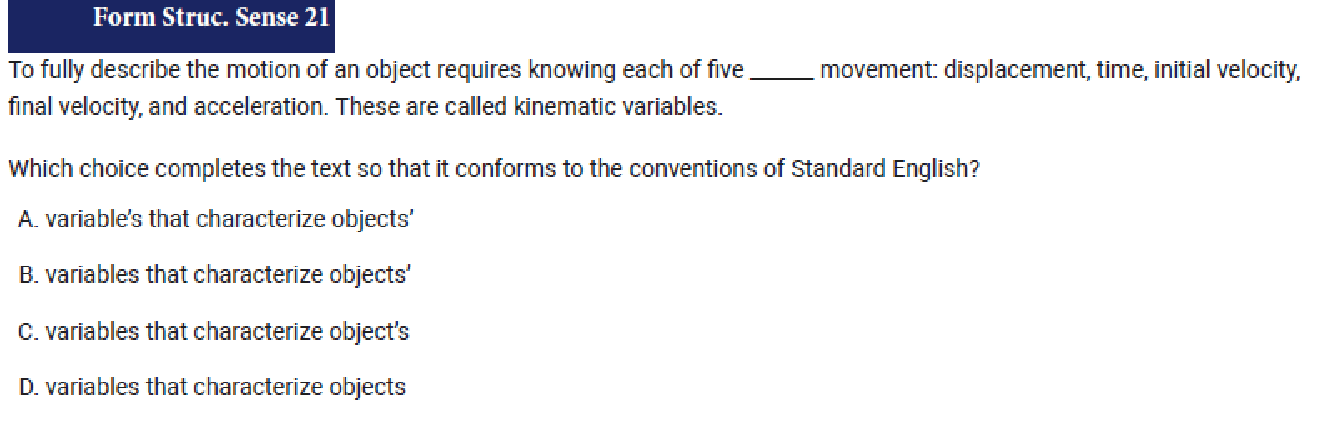
What tells you that we have to be referring to multiple “objects” in the blank rather than one “object”? This is important because it changes where you put the apostrophe
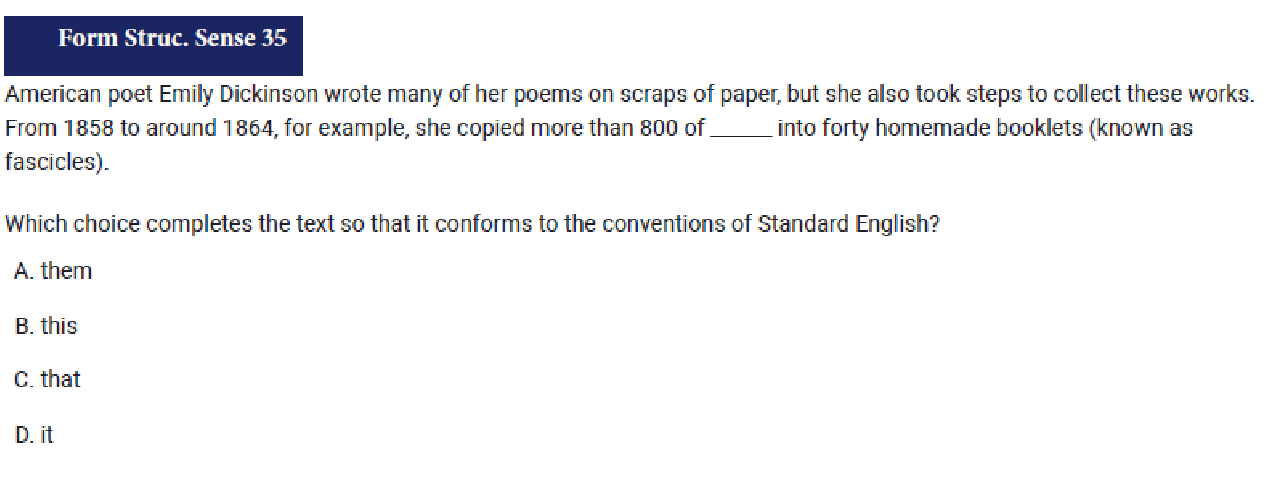
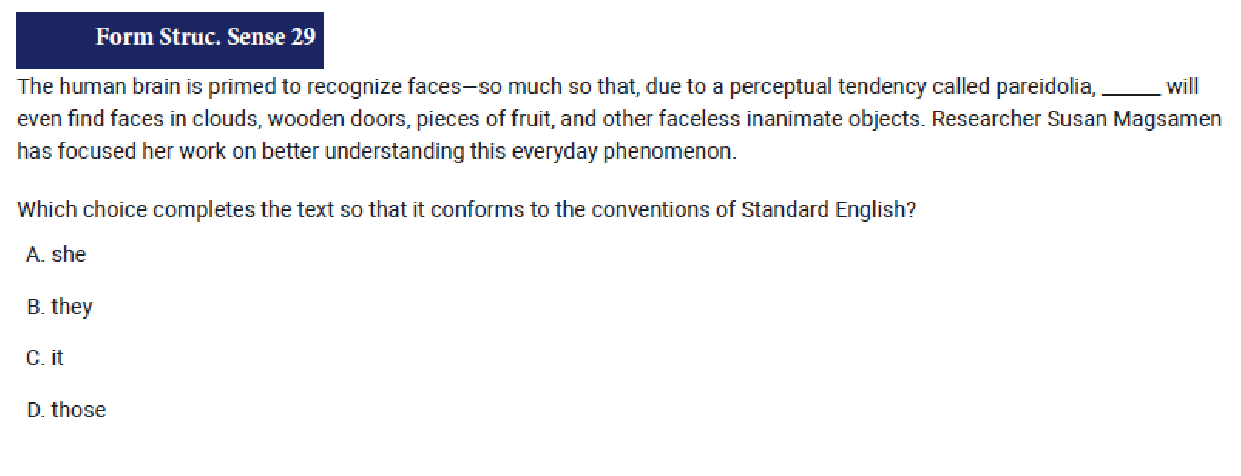
6) Pronouns
These questions bring in the singular-plural issue we saw in subject-verb agreement questions, but also involve knowledge particular to pronouns
In addition to personal and possessive pronouns, there are also demonstrative pronouns
“This,” “that,” “these,” and “those” are demonstratives—roughly, words you could use when pointing. They either function as adjectives, when a noun is after them, or as pronouns, when they have no noun after them
Demonstrative Adjective: I like these chairs
Demonstrative Pronoun: I need these
Demonstrative Adjective: That salesman came by again today
Demonstrative Pronoun: I wouldn’t buy that even at half the price.
As with subject-verb agreement questions, these questions often come down (at least partly) to singular vs plural. You need to recognize whether the antecedent of the pronoun—the noun it refers to—is singular or plural, and match that.
You also need to know that objects that aren’t people will be referred to as “it” in the singular. The plural will be “they” or “them” regardless of whether it refers to a person or an object.