SAT Grammar: Boundaries
“Boundaries” questions are about half the grammar (“Standard English Conventions”) questions on the SAT. Standard English Conventions, in turn, accounts for about 25% of the questions in SAT Reading/Writing—typically 6 or 7 of the 27 questions in each Reading/Writing module. In this post I’m going to break down Boundaries questions by type, with most types being organized by what's going on at the blank you're asked to fill in—which two things are being connected at that "joint." This accounts for four of the seven subtypes here.
Of course, the test won't announce to you whether you are joining two independent clauses or joining an independent clause to something that can't stand on its own (a phrase or dependent clause). So what we’re doing here is adding some temporary training wheels here to draw the patterns into focus.
Contact me if you see something on here you’d like elaborated on, and look out next week for a post on Form, Structure, and Sense, the other questions in Standard English Conventions.
All answers to included SAT question bank questions can be found most easily here, using the number at the top. All questions and answers originally come from the official SAT Question Bank, although I’ve added my own numbering for ease of communication. If you want to do the questions and check your answers as you read, I’d recommend clicking the bold link now so you have it ready.
What Are Boundaries Questions?
Boundaries questions cover all punctuation except for apostrophes—everything that is used to indicate joining and separation between thoughts in writing.
comma ,
period .
semicolon ;
colon :
question mark ?
em-dash —
left and right parentheses ()
quotation mark "
In form, structure, sense questions, answer choices differ primarily in terms of wording
Verb form (active or passive, singular or plural, tense, infinitive, mood)
Pronoun choice
Subject of a sentence
But also one punctuation mark, namely apostrophe ’
In fact, Standard English Conventions is the only part of Reading/Writing where they don't put the questions in a strict order—they freely mix up Boundaries questions with Form, Structure, and Sense questions. That's because they know that grammar is one area that gets less challenging when you know what the issue is. Figuring out from context what kind of grammar construction you need is part of the task, in their eyes. Also, on some hard Standard English Conventions questions, there are rules from both areas you need to be aware of.
However, for most questions, you can still tell whether a question is Form, Structure, Sense or Boundaries, by looking at whether the answer choices differ primarily in terms of the punctuation or primarily in terms of the wording.
Sentence Components Relevant in Boundaries Questions
• Independent Clauses
• Dependent Clauses
o Adverbial Clause
o Relative Clause (also called Adjective Clause)
o Noun Clause
• Phrases
o Many kinds
o Some key ones are participial, appositive, absolute
But don’t worry! Knowing the difference between a dependent clause and a phrase, or identifying types of phrases won’t be directly tested. What will matter is knowing which phrases or dependent clauses are essential to a sentence’s meaning and which aren’t.
So, we go over the specific types just to make the sentences easier to read. Other resources will have more detail on some of these topics.
Independent Clauses
An independent clause has three elements
Subject
Verb
Expresses a complete thought
Example:
I went to the store and bought cheese and bread.
Here there is a subject, “I,” and a compound verb, two things that I did: “went,” “bought.”
Dependent Clauses
Dependent clauses are missing the third element. They have a verb and either a subject or a pronoun standing in for a subject, but they don’t express a complete thought.
Types of Dependent Clauses
• Adverbial Clause: contain a complete independent clause but then make it dependent by sticking a subordinate conjunction in front.
Example:
After I went to the store, I read a book about whales.
• Relative Clause (also known as Adjective Clause): like a complete independent clause but one noun (subject, object, possessive) is replaced by a relative pronoun—e.g., who, whom, whose, whoever, that, which, where
Examples:
I went to the store that has those nice loaves of bread with seeds.
My dog, who really shouldn't eat bread, was sniffing the shopping bags.
• Noun Clause: functions as a noun. Can take either pattern (adds a word to an independent clause, or replaces a word of an independent clause).
Examples:
Everyone knows that dogs shouldn't eat chocolate
Whoever it was, I sure hope it wasn't Fido.
o The first of these, which starts with “that” and refers to a fact, is the more important type of noun clause for the test, because it can easily be used to make very confusing sentences.
Phrases
• Any collection of words in a sentence that doesn't have a main subject and main verb
• Some important kinds:
o Appositive Phrase: renames, redescribes, or clarifies
o Participial Phrases: starts with a participle, a verb acting as an adjective. These phrases are important for many Form, Structure, Sense questions: when used at the start of a sentence, the subject of the participle must be the subject of the sentence
o Absolute Phrase:
• Modifies the whole independent clause, rather than some noun in it
• Therefore, always unnecessary to the meaning
• Therefore, always has a comma between it and the independent clause, whether it comes before or after
Absolute phrase examples:
Their eyes drooping from exhaustion, they finally went to bed
I left the mall, my spirits considerably higher than they had been when I entered.
o Prepositional Phrase: a phrase starting with a preposition like “of,” “from,” “in,” “after,” etc.
Example:
The man in the green coat went out the door.
(Notice that in some grammar resources you’ll see a phrase starting with a preposition which will be referred to as either an adjective phrase or an adverb phrase. This is because in grammar you can talk about a phrase (like “in the green coat”) either based on what it’s made of (“prepositional phrase” because it starts with a preposition, in) or based on the role it plays in the sentence (“adjective phrase” because it describes a noun, man, which is what adjectives do,)
Question Types
We can think about most of the Boundaries question types (and all the most common ones) by thinking about the relationships between these various components.
1) Joining two independent clauses directly
2) Joining an independent clause and a phrase or dependent clause
3) A phrase or dependent clause in the middle of an independent clause
4) A long phrase between two independent clauses
Other Boundaries question types that are about smaller “joints”:
5) Compound verb, subject, or other component
6) Lists
7) Identifying whether a question is explicit (and needs a question mark) or implicit.
Joining Type 1: Joining Two Independent Clauses Directly

Green stands for independent clause, yellow stands for dependent clause or phrase, red circle stands for the blank you’re asked to fill in, and blue stands for “look here for a clue”
There are four main ways to do the punctuation when joining two independent clauses
Period (making two separate sentences)
Semicolon
Comma with one of the FANBOYS (for, and, nor, but, or, yet, so)
Colon in special cases—when the independent clause after the colon fleshes out the independent clause before the colon
A long dash or em-dash can be used in similar cases to a colon. There are some subtle differences, but that’s not something they’d test. The SAT likes to keep things pretty clear-cut. But you shouldn’t expect an em-dash joining two independent clauses to be used in an answer choice, for the same reason.
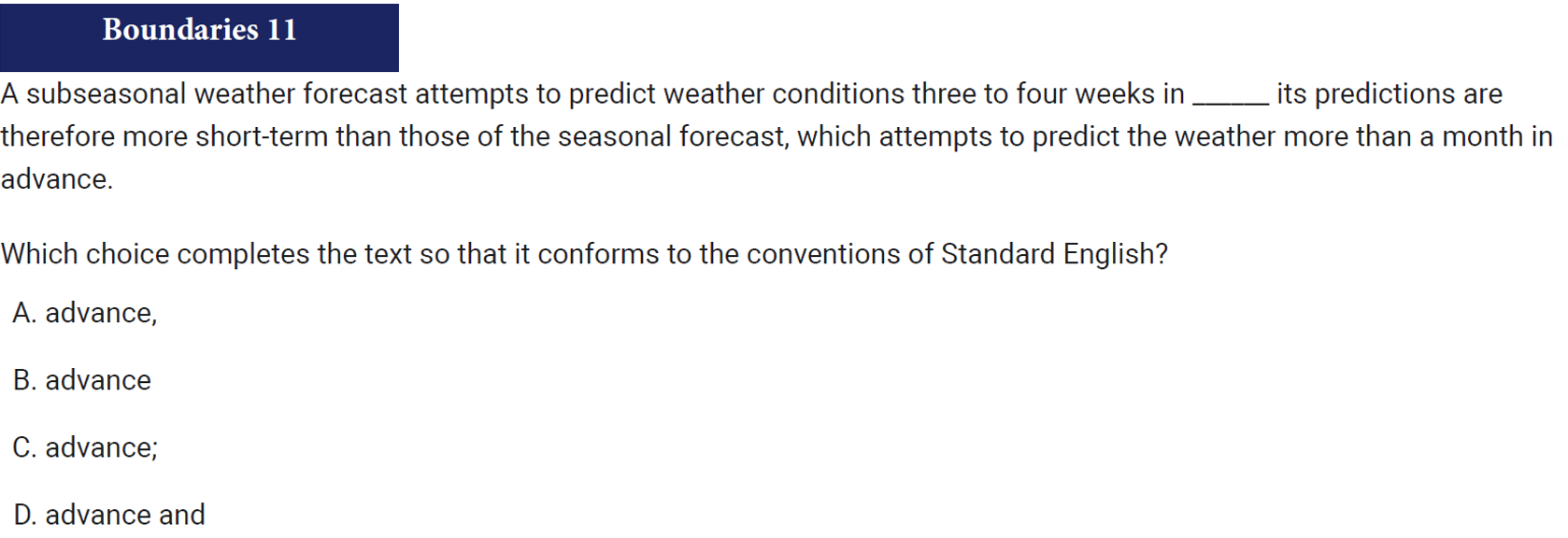
One test strategy point to note: when a question involves joining two independent clauses, the 3 wrong answers often follow the same pattern: one is a comma without FANBOYS, one has a FANBOYS with no comma, and one has no punctuation connecting the two independent clauses.
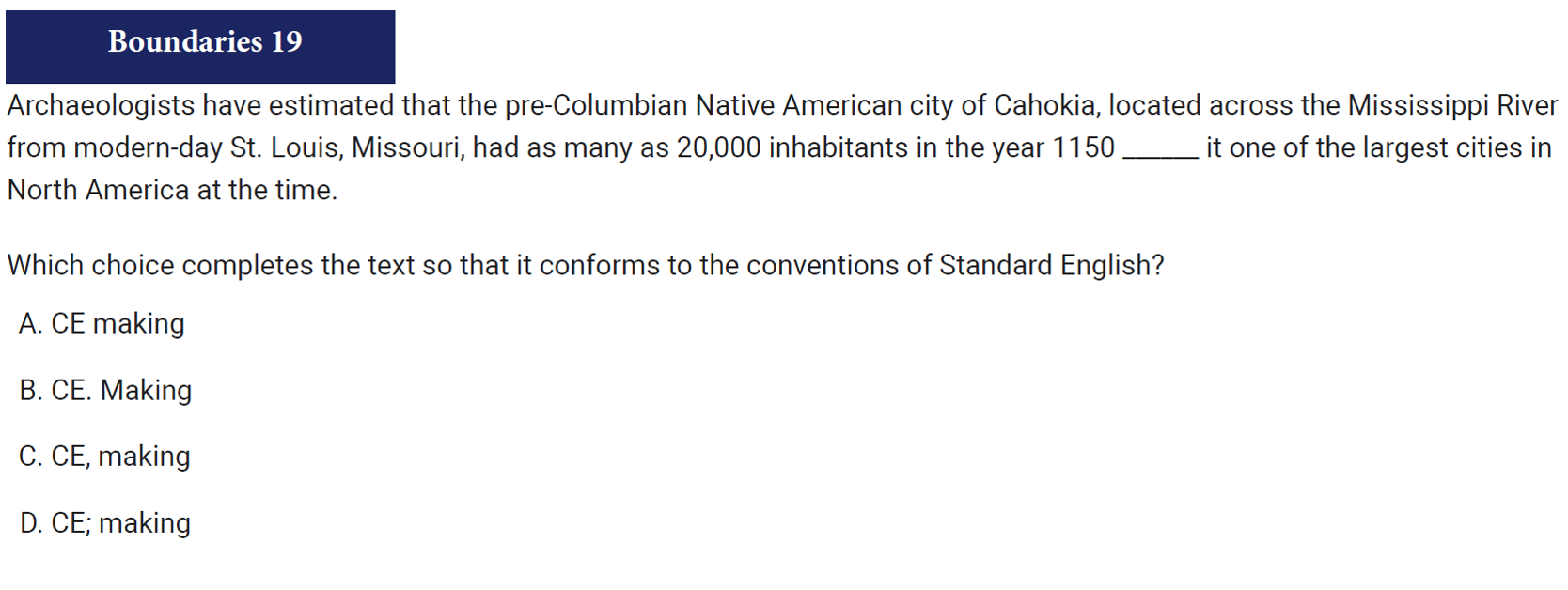
Joining Type 2: Joining an Independent Clause and a Phrase or Dependent Clause
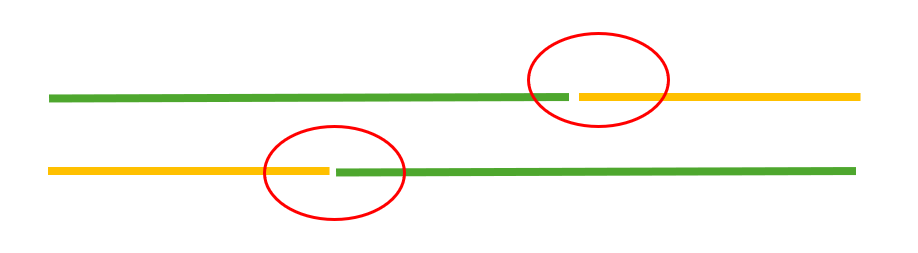
Green stands for independent clause, yellow stands for dependent clause or phrase, red circle stands for the blank you’re asked to fill in, and blue stands for “look here for a clue”
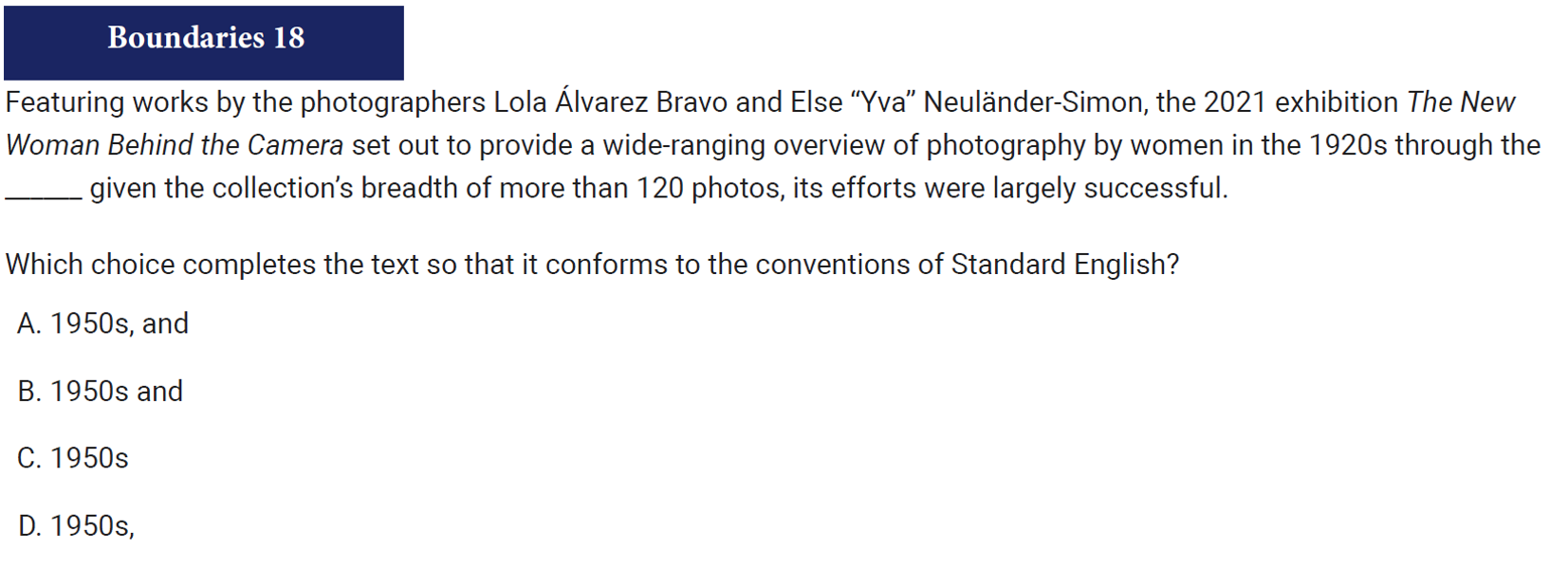
• The typical ways of joining independent clauses—a period, a semicolon, a comma with FANBOYS—will be “too much” of a pause here, and a colon usually won’t make sense
• So your typical choices are either a comma or no punctuation
• Which is right depends on whether the meaning of the independent clause makes sense without the phrase or dependent clause included
• If the dependent clause or phrase is optional, a comma is needed
• If it is essential, a comma is not needed
• The special case where a colon works is when the phrase comes after and answers an implicit question at the end of the independent clause
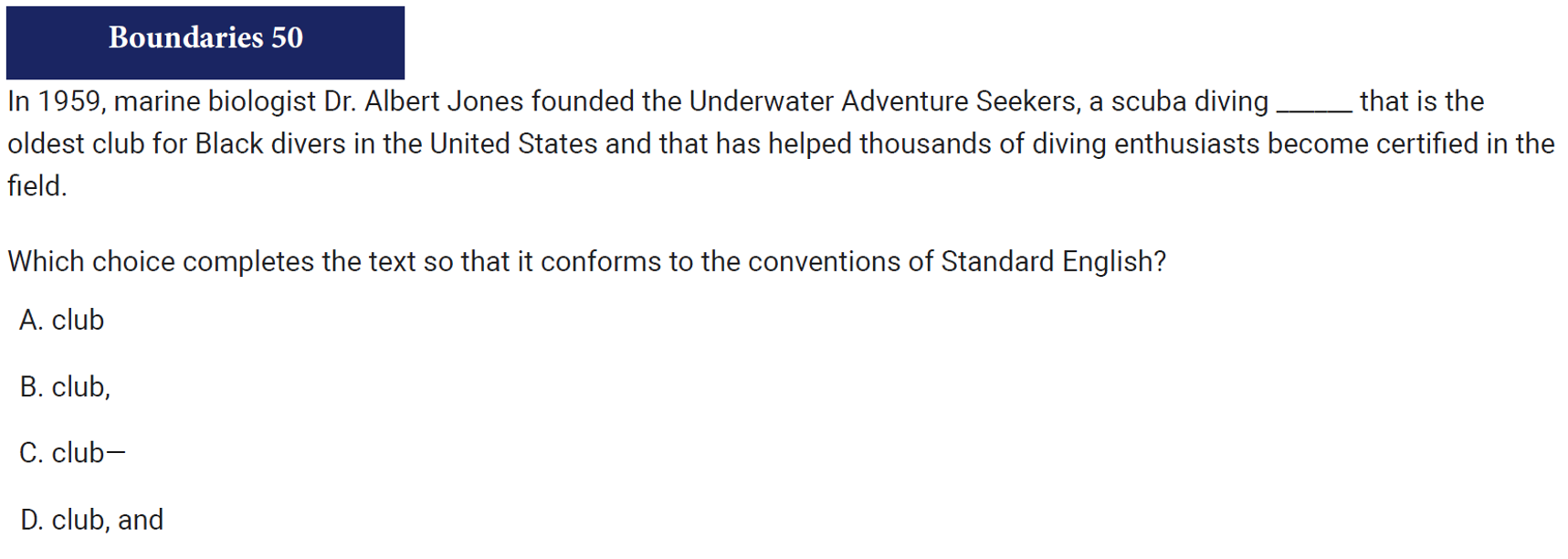
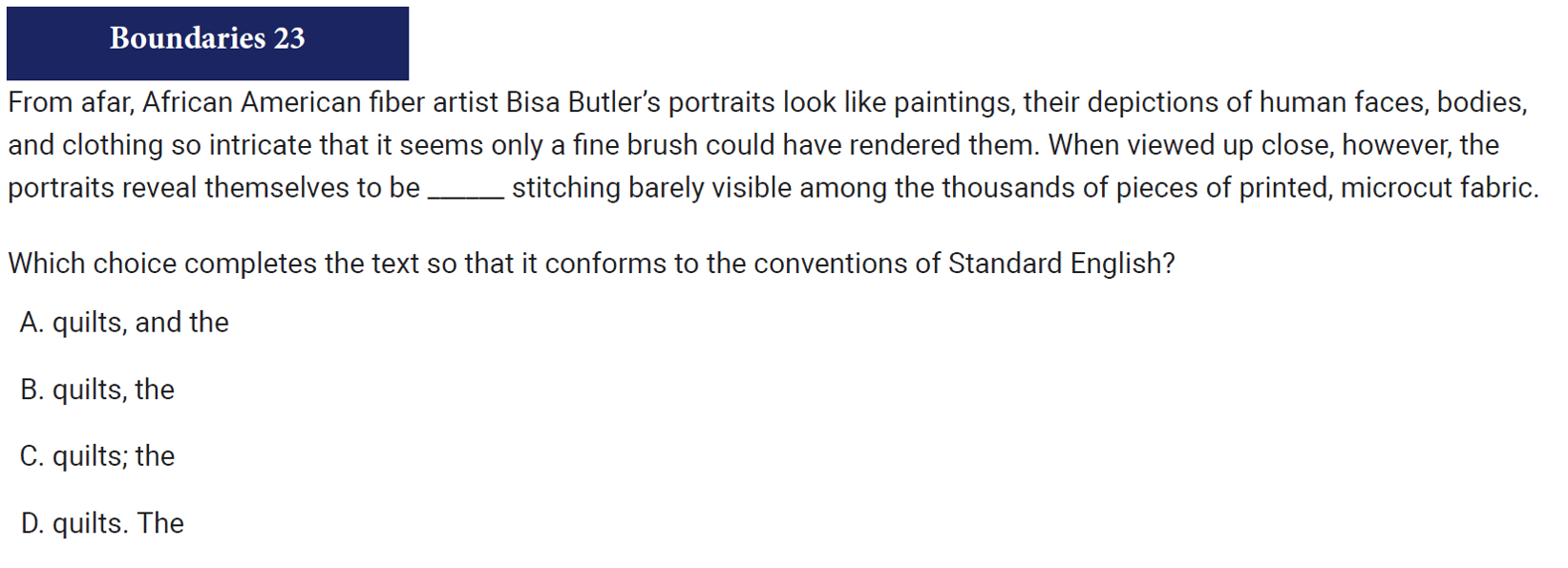
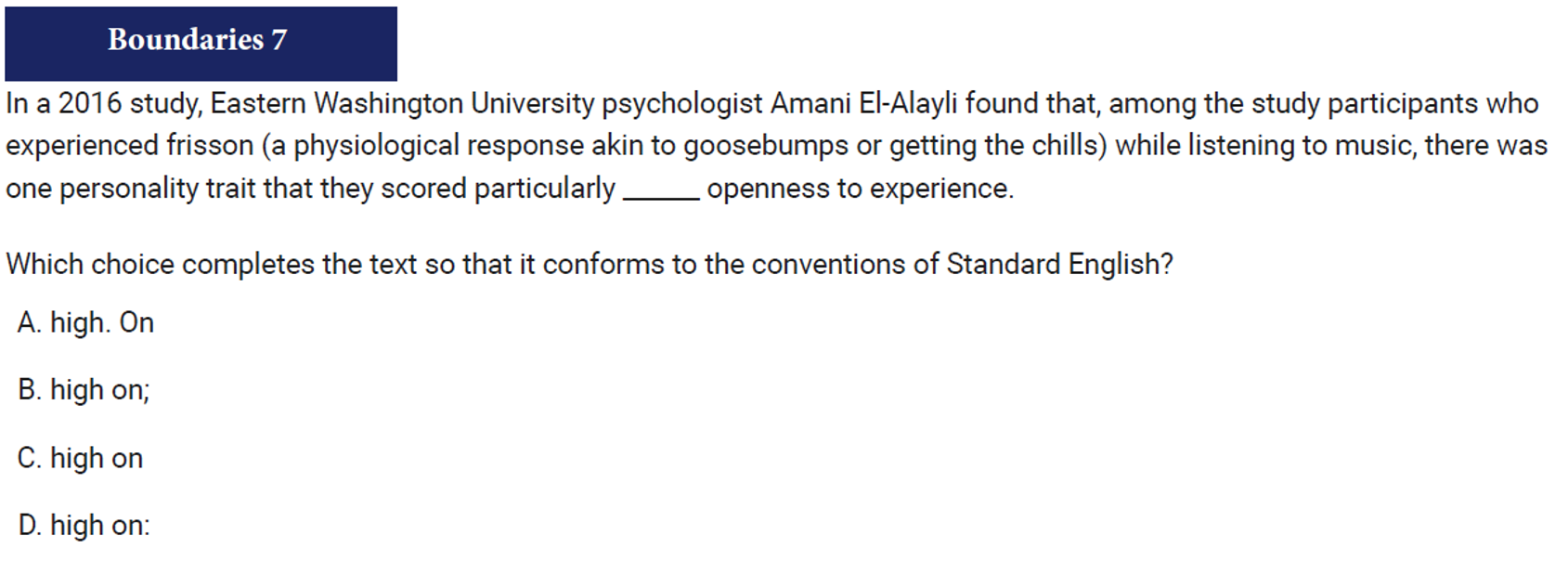
Joining Type 3: A Phrase or Dependent Clause in the Middle of an Independent Clause

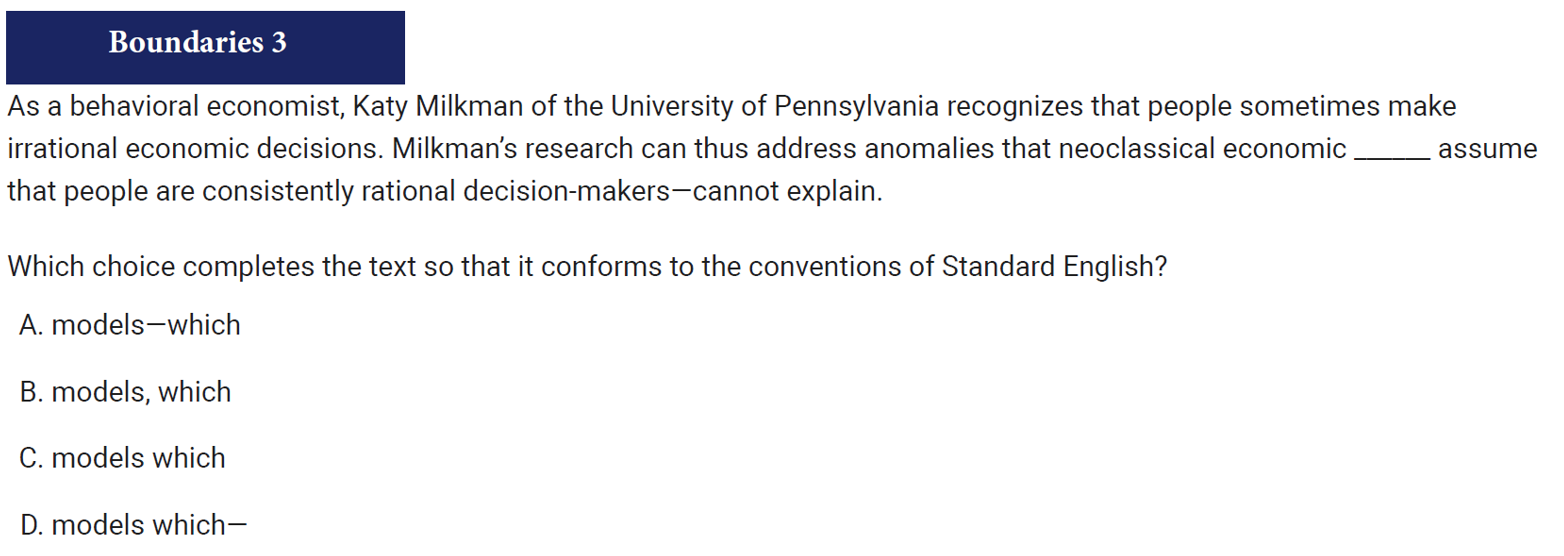
Green stands for independent clause, yellow stands for dependent clause or phrase, red circle stands for the blank you’re asked to fill in, and blue stands for “look here for a clue”
• In these questions you have some help: there is typically already punctuation on one side of the phrase, and you just have to match that punctuation on the other end.
• This could be a comma, an em-dash, or a left or right parenthesis
• But you can also confirm by relying on your sense of how much of a pause is appropriate. If your gut tells you that no pause is needed, but you see an em-dash later in the sentence that you think you need to match, you may be reading the sentence wrong, so double-check.
• Sometimes, with a short phrase, both ends of the phrase may be in the blank, and then your task is just to make sure that you pick an answer with both ends matching.
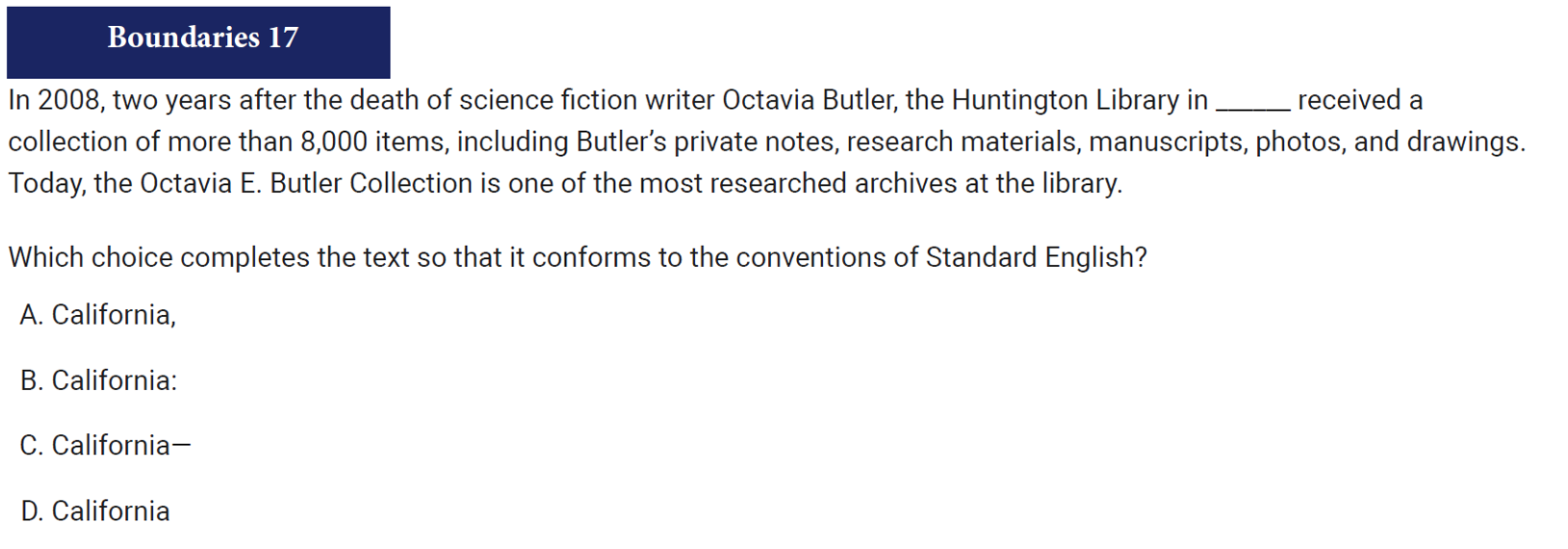
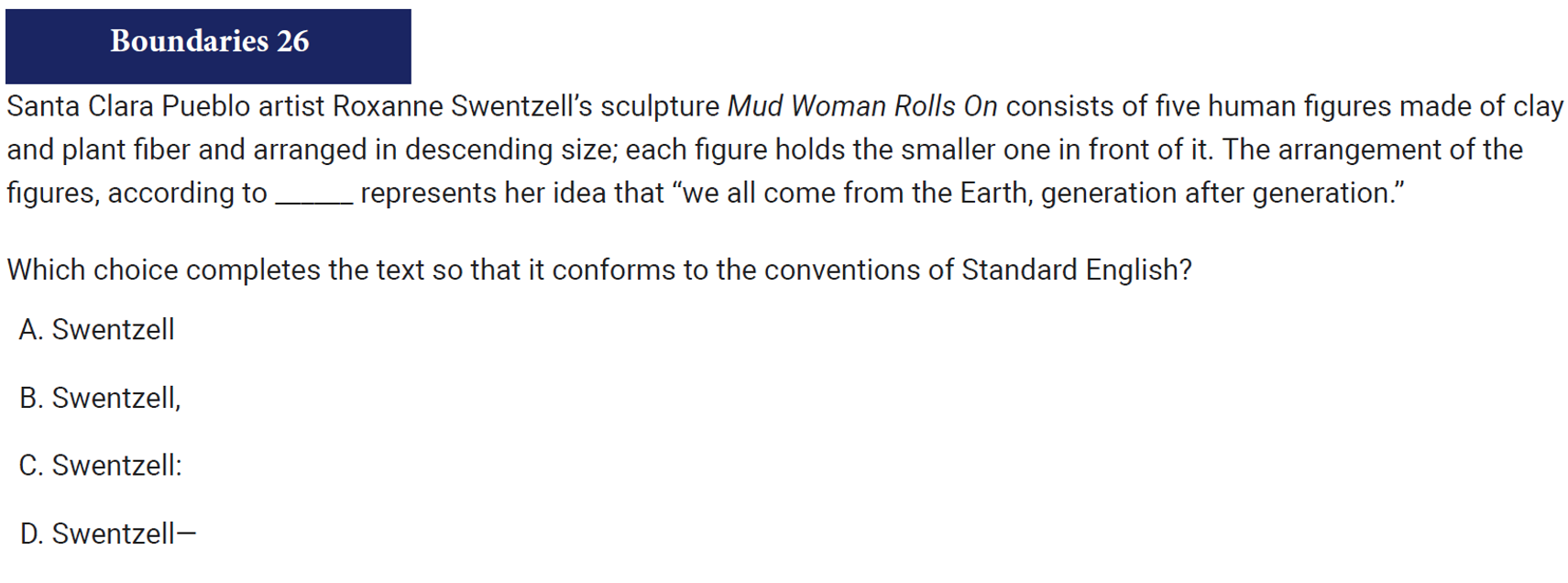
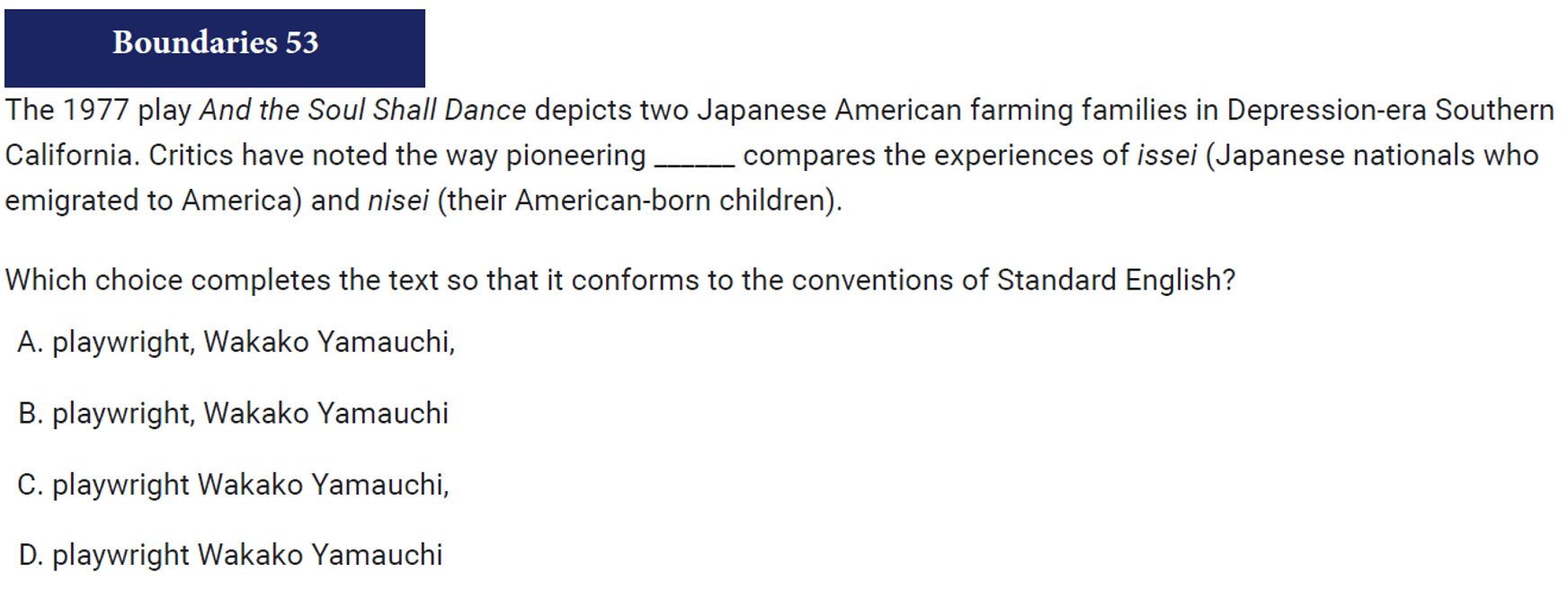
One variant on this type is short appositive phrases
• As mentioned above, appositive phrases rename, redescribe, or clarify
• A frequently used example on the test is a name following a title
• As in “former President Barack Obama,” where “former President” is the title and “Barack Obama” is the name and hence the appositive phrase
• As with all phrases, the name will be offset by commas if it is unnecessary to the meaning. In this case, the name is only unnecessary if the title already picked out the person exactly
• Since there is more than one former President, the name Barack Obama is necessary for the meaning, so no comma is needed
• The SAT typically uses names that are necessary and so don’t require a comma
• For other kinds of appositive phrases that aren’t a name, determine whether it is necessary, or look at the end outside the blank
Joining Type 4: A (Long or Medium) Phrase Between Two Independent Clauses

Green stands for independent clause, yellow stands for dependent clause or phrase, red circle stands for the blank you’re asked to fill in, and blue stands for “look here for a clue”
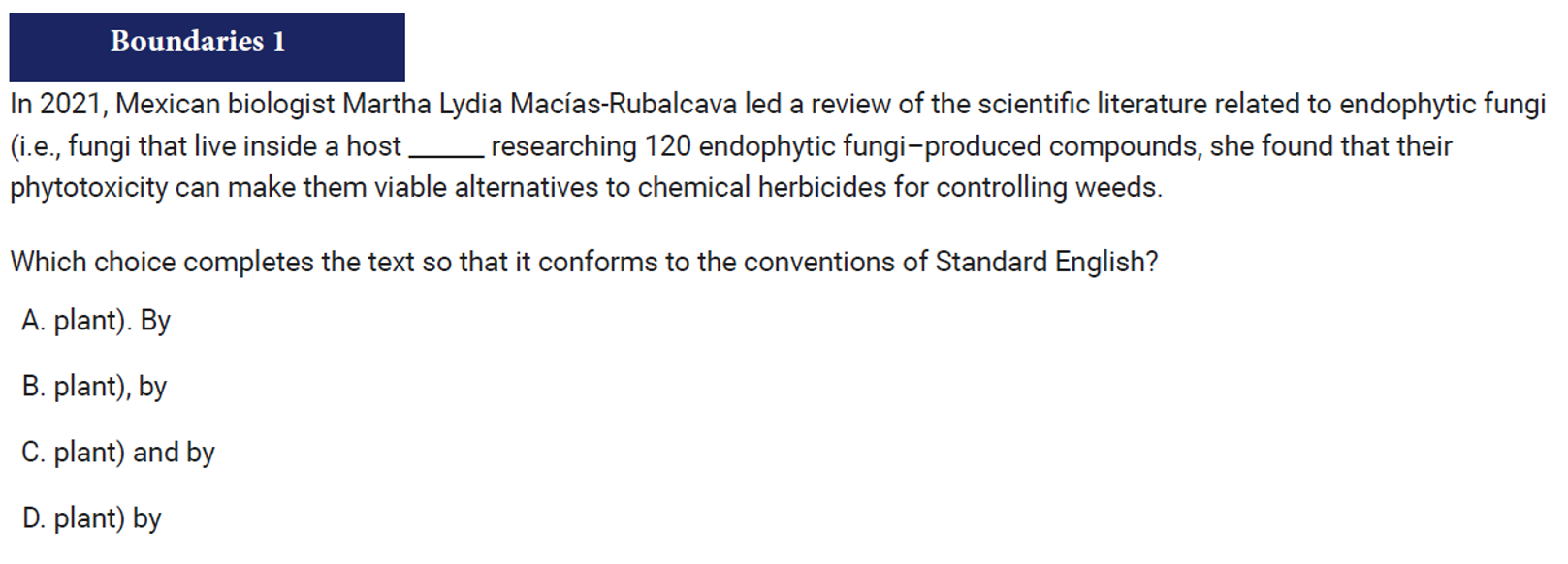
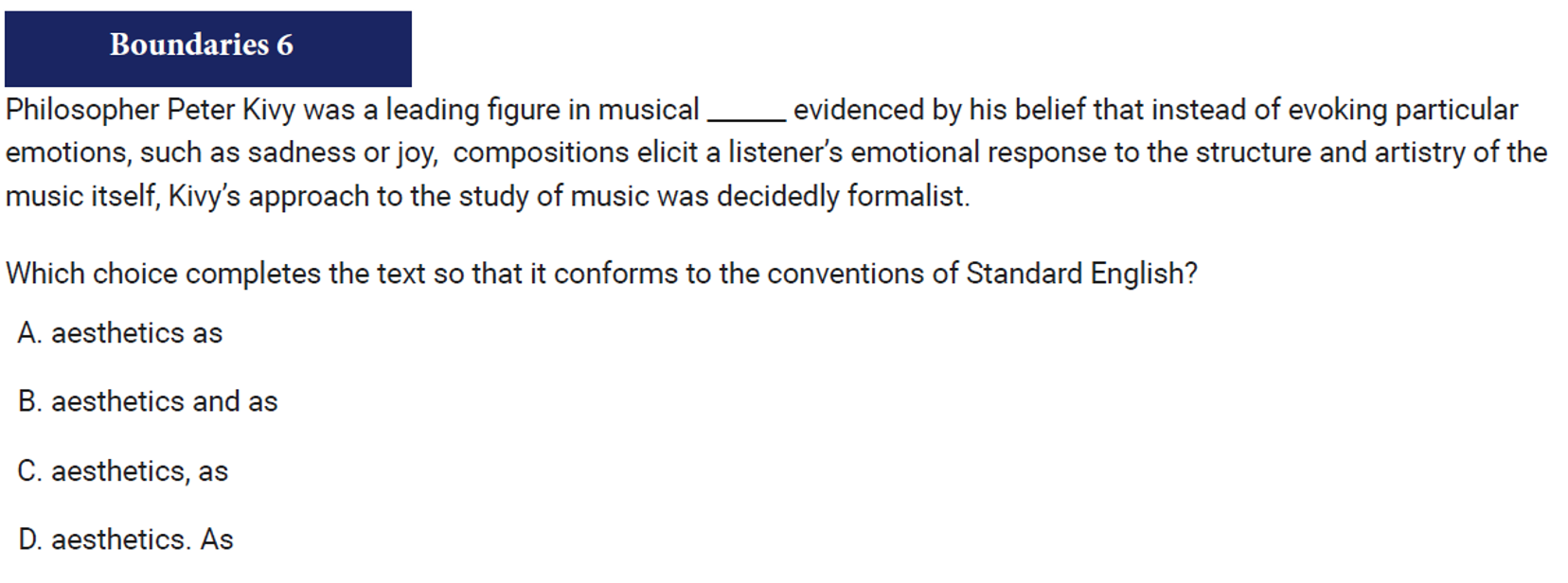
• Because the phrase is attached to one of the two, this is usually another case of joining independent clauses. What really separates this group from the first group as you’re reading the question is that it’s hard to see at first glance whether the phrase after the blank belongs to the first independent clause or the second.
• You can use what’s going on at the other joint to determine whether to end the first independent clause in the blank
• If the joint that is filled in (blue arrow) contains a separation between two independent clauses, the right answer choice should keep the phrase attached to the first independent clause (look at joining type 2 above).
• If the joint that is filled in has just a comma with no FANBOYS, or no punctuation at all, then end the first independent clause in the blank (using the options from joining type 1 above). This second option is more common
Other types of boundaries questions
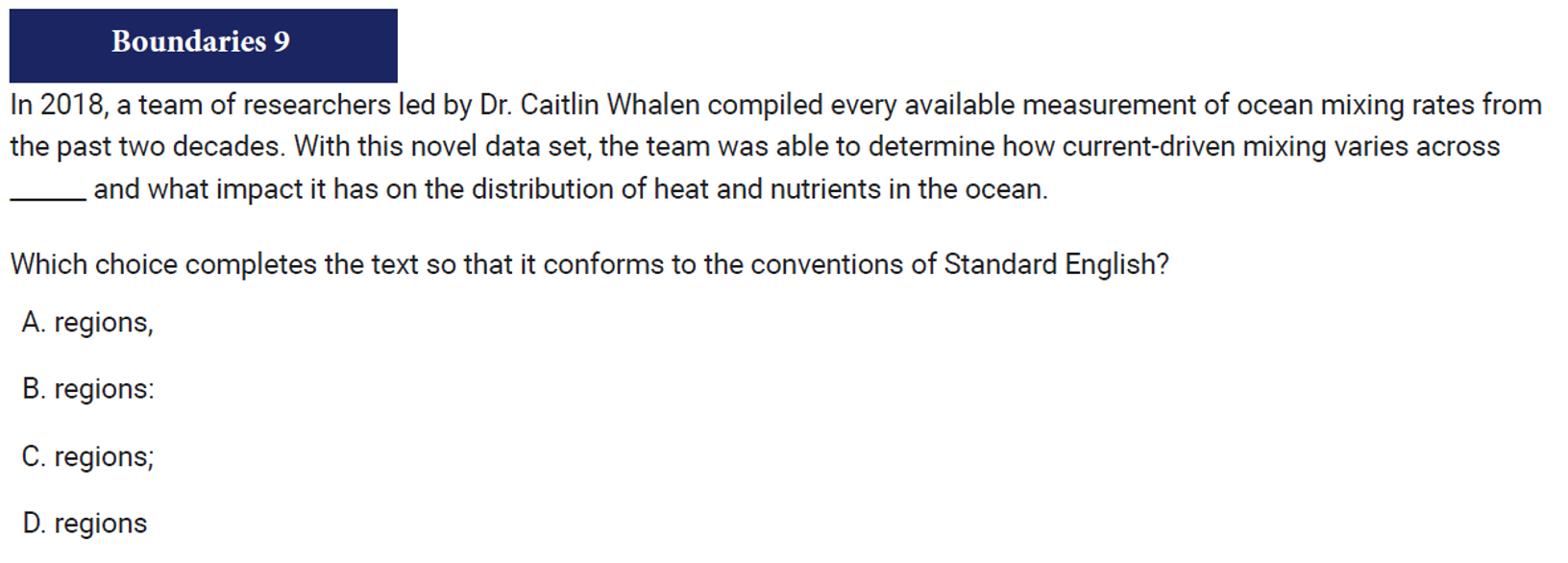
5) A Compound Subject, Verb, or Object within an Independent Clause
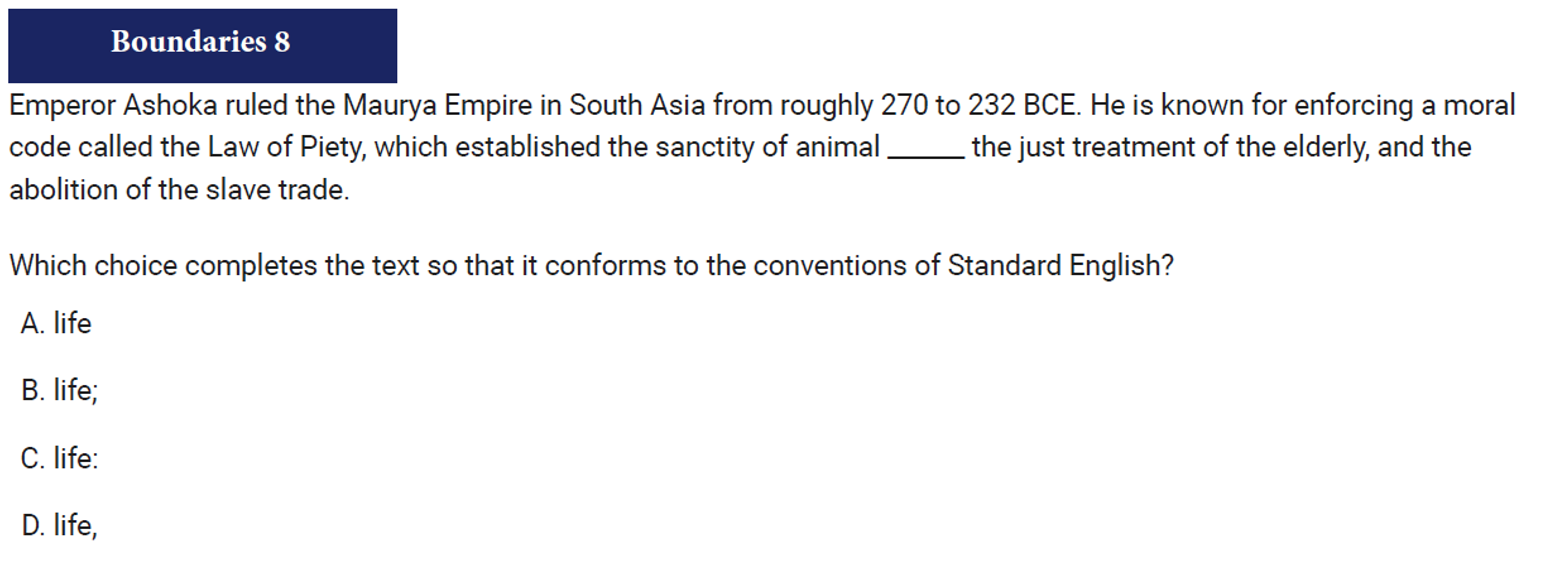
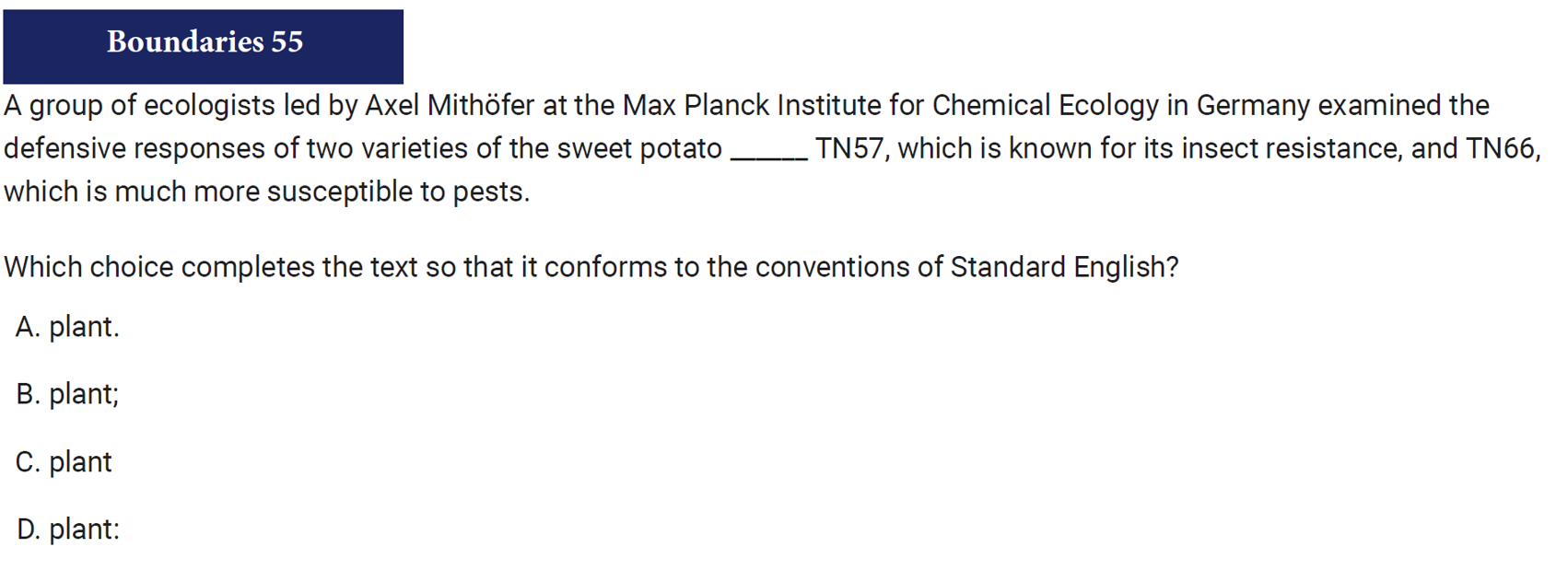
• If you have two nouns that are both the subject of a verb, two verbs that both apply to one subject, or another compound of two such as a compound object, you don’t need commas
• You do need commas (or semicolons) if there are three though. See “lists” below
6) Lists
You have two main questions to ask yourself when you see a list question
• 1. Is this a comma list or a semicolon list?
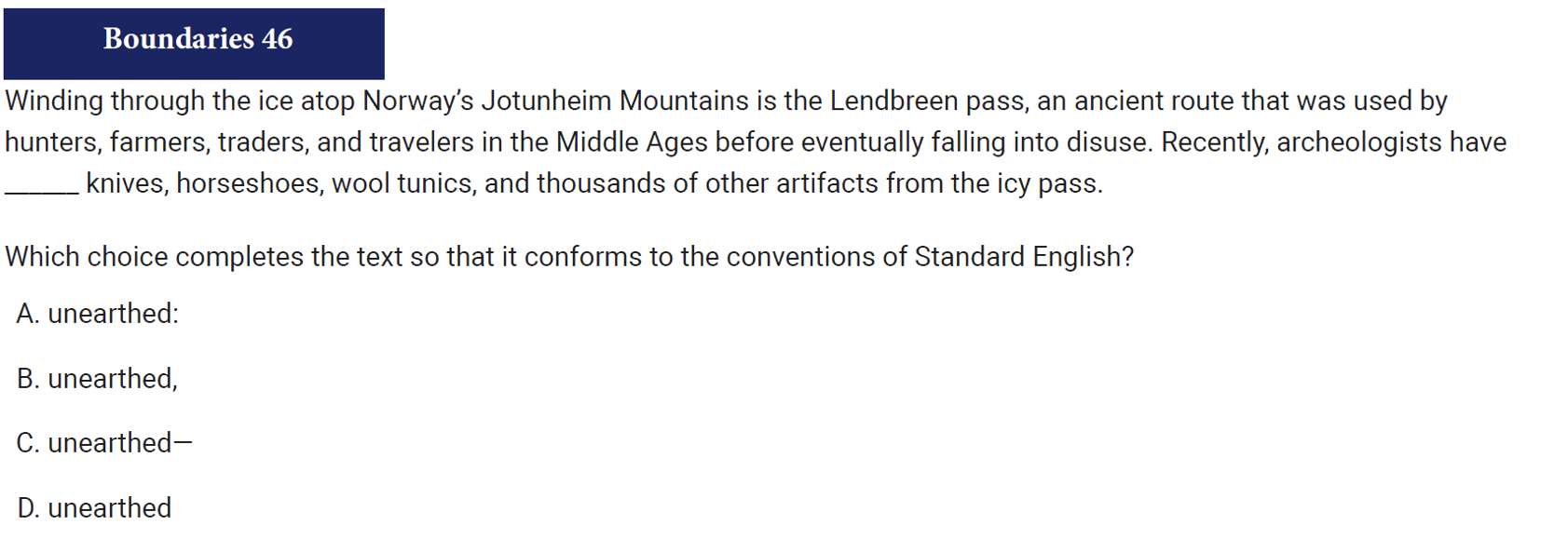
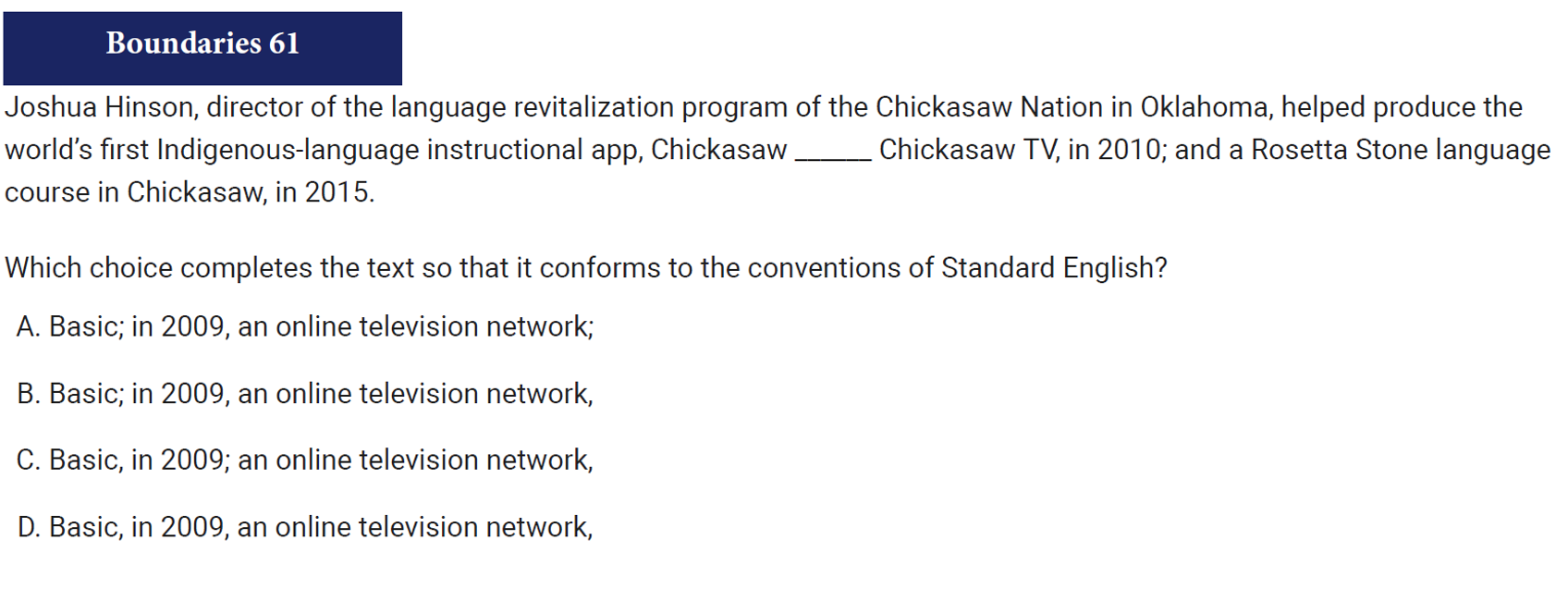
In ordinary writing, almost all lists are comma lists. But the SAT throws in semicolon lists as an extra challenge to see if you can keep parallelism with the rest of the sentence outside of the blank (and, presumably, to make sure the semicolon can’t be written off a one-trick pony which plays exactly the same role as a period). The rule is, a list of three or more items requires semicolons to separate its members if at least some of the members already contain commas.
• 2. Does this list require a colon to introduce it?
Most lists don’t require a colon to introduce them. The ones that do have some buildup, such that the list items spell out what was announced before the colon. Here’s a comparison.
At the store, I purchased celery, peanut butter, and plastic knives.
At the store, I purchased some key picnic ingredients: celery, peanut butter, and plastic knives.
Or better yet:
At the store, I purchased the following three things: celery, peanut butter, and plastic knives.
• You won’t be asked to decide on whether to use the Oxford comma--the comma between the penultimate (next-to-last) and last members of a list
• Possible third question arising in more advanced questions: is there a common structure to the list items (such as a date at the end)?
7) Is This a Question?
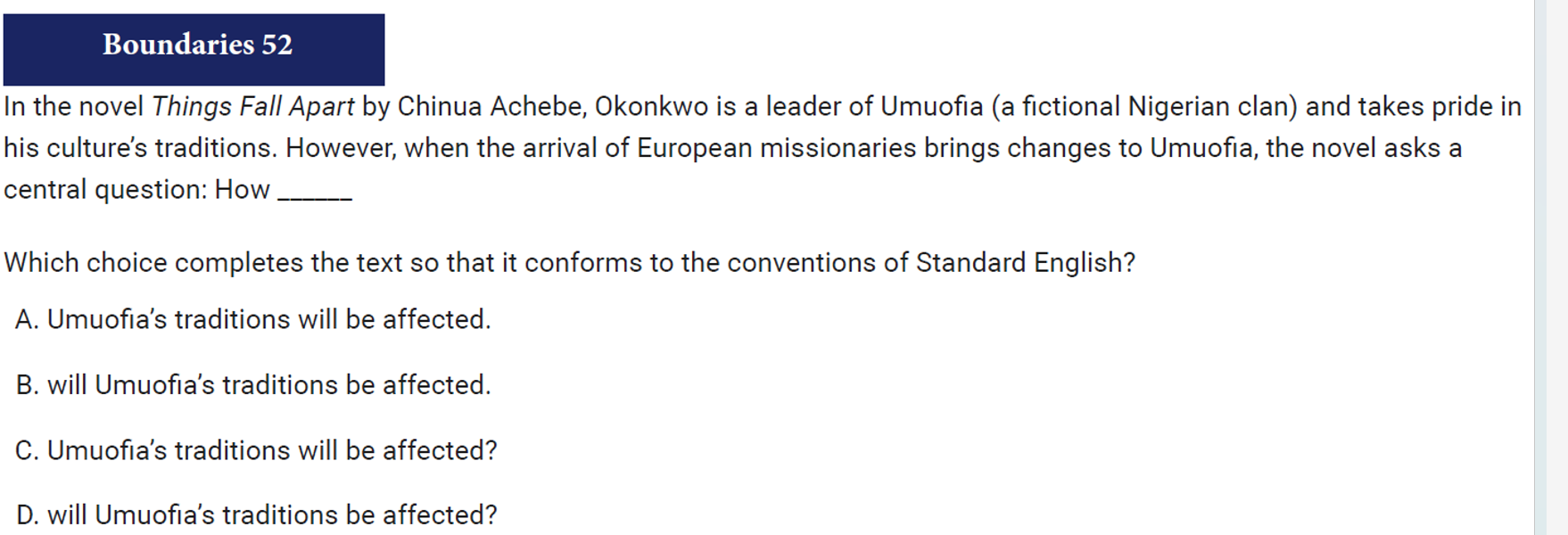
· In these questions, you have to figure out if a question is being asked explicitly, and so needs to be phrased and punctuated as a question, or implicitly, and so needs to be punctuated as a sentence ending in a noun clause or noun phrase. If a question is being asked explicitly, there are four signs to look out for, at least one of which will be outside the blank.
I want to find out for myself how so many ants made it into the cabinet.
I want to find out for myself:How did so many ants make it into the cabinet?
· If a question is being asked mid-sentence
1) there should be a colon before it
2) the first word of the question should capitalized—and of course,
3) a question mark should be at the end. Additionally,
4) putting a form of the helping verb “do” (did, does), “has” (have, had), “will”, “can,” “could,” “should,” “may,” etc., before the subject of the verb indicates a question.
All these things go together (in most writing, #2 is not really required, but in formal writing it’s helpful for clarity, and the SAT is good at being consistent, so expect it). So from a test strategy perspective, what we need to know is
An answer choice that uses some of these but neglects others can’t be right. That should rule out two answer choices.
At least one of these (probably #1 and #2) will be outside the blank. The correct answer will match those, so use those to determine the right answer.
That is, if there’s a colon and a capitalized first word outside the blank, then the part in the blank needs a question mark and a helping verb before the subject
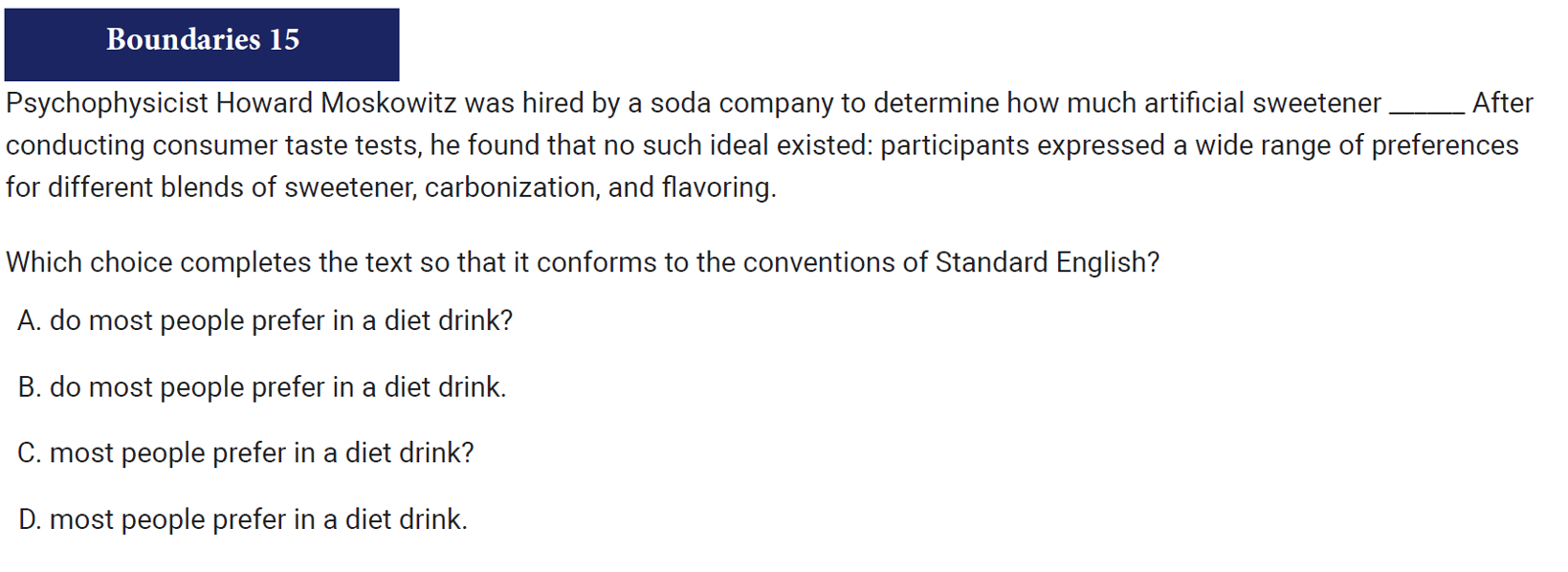
· For example, in question 15 below, choice D is right if the part outside the blank indicates a question is not being asked, whereas choice A would be right if the part outside the blank indicates a question is being asked. But choices B and C could never be right because they’re a hybrid of the two grammatical conventions—“do” in B indicates a question but is followed by a period, whereas C has a question mark but no helping verb before the subject (“most people”). If you’re not sure whether it’s A or D, look at the previous bullet point.